Thursday, July 12, 2007
Bobby Darling out of Big Boss
This video is mostly in Hindi. Nevertheless, if you don't understand what's being said there's still plenty of nonverbal action to observe as Bobby is evicted from the reality show "Big Boss."


Contracepting the Environment
Environmentalists Mum on Poisoned Streams
BY WAYNE LAUGESEN
REGISTER CORRESPONDENT
July 15-21, 2007 Issue | Posted 7/10/07 at 2:25 PM

BOULDER, Colo. — When EPA-funded scientists at the University of Colorado studied fish in a pristine mountain stream known as Boulder Creek two years ago, they were shocked. Randomly netting 123 trout and other fish downstream from the city’s sewer plant, they found that 101 were female, 12 were male, and 10 were strange “intersex” fish with male and female features.
It’s “the first thing that I’ve seen as a scientist that really scared me,” said then 59-year-old University of Colorado biologist John Woodling, speaking to the Denver Post in 2005.
They studied the fish and decided the main culprits were estrogens and other steroid hormones from birth control pills and patches, excreted in urine into the city’s sewage system and then into the creek.
Woodling, University of Colorado physiology professor David Norris, and their EPA-study team were among the first scientists in the country to learn that a slurry of hormones, antibiotics, caffeine and steroids is coursing down the nation’s waterways, threatening fish and contaminating drinking water.
Since their findings, stories have been emerging everywhere. Scientists in western Washington found that synthetic estrogen — a common ingredient in oral contraceptives — drastically reduces the fertility of male rainbow trout.
Doug Myers, wetlands and habitat specialist for Washington State’s Puget Sound Action Team, told the Seattle Post-Intelligencer that in frogs, river otters and fish, scientists are “finding the presence of female hormones making the male species less male.” . . .
UK News: Why Ambiguous Avatars Are A Turn Off
Ambiguous "avatars" - or virtual humans - used by internet users to represent themselves are off-putting if they look like pop star David Bowie in his 1970s gender-bending days.
It turns out we find androgynous computer generated images less trustworthy than those who are clearly male or female.
People regularly use avatars online while chatting with friends or exploring virtual worlds and companies are increasingly using them to interact with customers.
To find out whether your choice of avatar affects how others perceive you researchers Kristine Nowak and Christian Rauh of the University of Connecticut paired up volunteers and asked them to chat by typing messages into a computer.
Although they didn't meet face to face each person was shown a computer-generated image representing the other person.
These avatars ranged from an obviously female blonde to ones with no clear gender to strong-jawed males, reports New Scientist.
When asked to rate the other person the volunteers found those represented by androgynous-looking avatars less
"credible".
Similarly a second group of volunteers was asked to make snap judgements based on a glimpse of the images - and they were also less willing to trust the androgynous ones.
The researchers say androgyny makes avatars appear less human causing a breakdown in trust and people should consider this when selecting one. Distrust could also stem from a lack of context.
"If someone says 'that's so sweet' was it sisterly or patronising," asks Judith Donath of Massachusetts Institute of Technology's Media Lab."
If it's difficult to tell knowing someone's gender can help you sort it out, she says.
It turns out we find androgynous computer generated images less trustworthy than those who are clearly male or female.
People regularly use avatars online while chatting with friends or exploring virtual worlds and companies are increasingly using them to interact with customers.
To find out whether your choice of avatar affects how others perceive you researchers Kristine Nowak and Christian Rauh of the University of Connecticut paired up volunteers and asked them to chat by typing messages into a computer.
Although they didn't meet face to face each person was shown a computer-generated image representing the other person.
These avatars ranged from an obviously female blonde to ones with no clear gender to strong-jawed males, reports New Scientist.
When asked to rate the other person the volunteers found those represented by androgynous-looking avatars less
"credible".
Similarly a second group of volunteers was asked to make snap judgements based on a glimpse of the images - and they were also less willing to trust the androgynous ones.
The researchers say androgyny makes avatars appear less human causing a breakdown in trust and people should consider this when selecting one. Distrust could also stem from a lack of context.
"If someone says 'that's so sweet' was it sisterly or patronising," asks Judith Donath of Massachusetts Institute of Technology's Media Lab."
If it's difficult to tell knowing someone's gender can help you sort it out, she says.
Sonia Faleiro. . .more on Bobby Darling
Friday, 25 November 2005
Liberty! Equality! Fraternity!
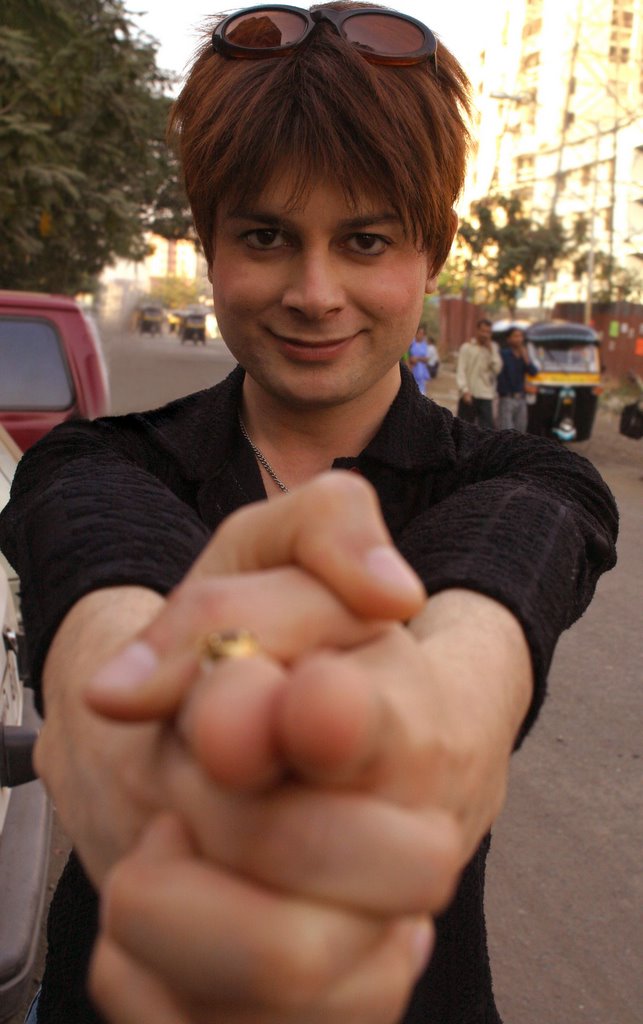
As a boy, Pankaj Sharma realised he preferred being a woman. He paid for his ‘deviance’ when his father disowned him. Giving up was not in his script. So he ran away to Mumbai to reinvent himself. Today, he is Bobby Darling, the actor who redefines gender anew in a conservative industry, writes Sonia Faleiro.
Bobby Darling totters down the road in transparent block heels embroidered with pink flowers, denim hipsters, and a black lace shirt. One long white finger is crowned with a diamond, on another, a moonstone catches the light. His glossy brown hair switch, 12 o’ clock shadow, and a hint of cleavage induced by hormone pills he started taking five months ago, encourage a group of little boys to feign a drunken stagger: “Bobby Darling, oh Bobby Darling!” Another crowd of children, can’t get enough of the actor. “Bobby Darling!” they sigh, cuddling him. Bobby Darling appears impervious to the first reaction, and at the second, smiles, tosses his hair, wiggles a manicured finger: “Go wash your hands, first.” . . .
India: Interview with television & film actor Bobby Darling
| |||
| Posted on 28 February 2004 | |||
| How could we have bypassed an extremely unusual face on the small and big screen both? Our sleuths inform us that he is a gay who does not go by his actual name Pankaj Sharma but calls himself Bobby Darling. Big deal! What surprises, sorry, shocks us is the additional information that he is screaming from the rooftops about his deviant sexual behaviour. We track him down on his mobile and he invites us home. I express that it would be better if we catch up at a food or a coffee joint. He laughs, "Are you scared?" We have been challenged. An hour later, we are ringing his doorbell. It's pitch dark inside. No one attends. We are about to return. Just before we turn back, he comes roaring from behind, in a sleeveless T-shirt. "Hi," he nearly shrieks. As we enter his flat, we start straight-away. We are feeling slightly uncomfortable and would prefer to finish this fast. Here's an excerpt of what transpired between indiantelevision.com's Vickey Lalwani and Bobby Darling: | |||
| Being a gay, how did you get into films? | |||
| | |||
| But what makes you go so open? | |||
| | |||
| Rolling backwards. When and how did you realize that you were a gay? | |||
| | |||
| What happened when his parents came to know? | |||
| | |||
| And then? | |||

D.C. marks the first-ever Transgender Awareness Month
by Yusef Najafi 
Published on July 12, 2007
If you haven't been to Unity Fellowship Church in Northwest in the past two weeks, you might not know that it's Transgender Awareness Month. But for those in the know, including local transgender activist Toni Collins, , it's a positive effort to bring the GLBT community closer together by building awareness about its transgender members.
''It's really still a very marginalized community and we're just trying to strengthen our bond between the [GLBT] community by making the community aware that we have a voice,'' says Collins, a board member of Transgender Health Empowerment (THE).
Published on July 12, 2007
If you haven't been to Unity Fellowship Church in Northwest in the past two weeks, you might not know that it's Transgender Awareness Month. But for those in the know, including local transgender activist Toni Collins, , it's a positive effort to bring the GLBT community closer together by building awareness about its transgender members.
''It's really still a very marginalized community and we're just trying to strengthen our bond between the [GLBT] community by making the community aware that we have a voice,'' says Collins, a board member of Transgender Health Empowerment (THE).
The awareness month events at Unity Fellowship, organized by THE and a planning committee, mark the first Transgender Awareness Month in Washington, Collins says. . . .
Wednesday, July 11, 2007
Follow-Up: More Info for Gender Variant Children and Their Parents
Wed Jul 11, 2007 at 12:50:21 PM
Re: this week's cover feature by Lauren Smiley ("Girl/Boy Interrupted -- A New Treatment For Transgender Kids Puts Puberty On Hold So That They Won't Develop Into Their Biological Sex"), parents with gender variant children can access a growing number of resources:
A support group for Bay Area parents of gender variant and transgender children, co-sponsored by Children’s Hospital Oakland.
The first Gender Odyssey Family Conference is scheduled for Labor Day weekend in Seattle, Washington. The conference will provide family programming for gender variant or transgender children and adolescents.
TransYouth Family Advocates is an organization dedicated to raising awareness of the cultural and medical issues facing transgender youth and families.
The PFLAG Transgender Network provides resources for families and produces an online newsletter called eTransParent.
The World Professional Association for Transgender Health (WPATH) approved the GnRH blocking treatment for adolescents in its most recent treatment guidelines.
The Gender Identity and Research Society (GIRES) is a UK-based non-profit. Its website includes information on GnRH blocking treatment. Click on “Endocrine Treatment for Adolescents” in the left-hand panel.
The Dimensions Clinic in San Francisco provides medical care for transgender teens.
The Transgender Law Center is a San Francisco-based civil rights organization.
For a list of additional transgender resources, check out the list compiled by ABC News.
Looking Back: Better Than Nothing
Gary Johnson is about to become the first transsexual to sue for discrimination under a new state law. The only catch: He must admit to being "disabled."
By Bernice Yeung
Published: April 18, 2001Gaynell Johnson was 5 when she showed the first signs of being transsexual. After a kindergarten class one day, she told her mother she wanted to marry her teacher. "You can't marry her, you're a girl," Gaynell's mother informed her, thinking that the young girl was confusing affection for attraction.
"I'm not a girl. I want to be a boy," Gaynell responded. "And when I grow up, I want to marry a woman."
Nearly 30 years later -- after a failed marriage and living for 12 years as a lesbian -- Johnson has adopted a male perso-na and goes by the name Gary, the person Gaynell has always wanted to be.
Johnson says that last year he finally came to terms with his transgenderism and began living and dressing as a man outside of work. To transition from being female to male, he says, he began dressing more masculine for work at a Sacramento nonprofit organization. He had interviewed for his job as Gaynell but says he was trying to fully transition in all aspects of his life.
But during that transition Johnson suffered what he considers to be discrimination, and this week, he will become the first Californian to file a lawsuit against his employer by using a new state law that protects transsexuals from discrimination in housing and employment.
Johnson's attorneys will also file a similar lawsuit for a Santa Cruz woman who believes she was refused a job at a health club because she is a male-to-female transsexual. . . .
Going on a gender bender at Truck
Katy St. Clair
Published: June 20, 2007One of the best things about being a higher primate is our penchant for self-expression — opposable thumbs and tool-making notwithstanding. To put a finer point on it, duckbill platypuses do not wear black eyeliner and Joy Division T-shirts. Snails do not attach flame decals to their shells. Three-toed sloths ain't hyphy.
There are probably fewer cities in the world that value individuality and self-expression more than San Francisco. Here we conform to nonconformity, meaning we all look somewhat "different," yet alike: Same hip haircuts that would stand out in Danville; same cutoff pants that would look fashion-forward in Needles; same penchant for flaunting our undiscovered Brazilian garage band 45s from the '60s.
Of course not everyone here is trying to stand out. Even if you don't count yourself among the hip masses, you are still expressing yourself on a very basic level, through gender. You dress like a "girl" or a "boy."
I am a firm believer in gender. You are born with it; it is not an environmental construction. Now, that is not to say that you can't be born with male parts and the deep-down gender of a female. What I am saying is that your gender, and however it will play itself out, is fixed at birth. . . .
Girl/Boy Interrupted
A new treatment for transgender kids puts puberty on hold so that they won't develop into their biological sex
By LAUREN SMILEY
Published: July 11, 2007The breast bud popped up about six months ago, and Marty knew something had to be done. It was the slightest of puckers, just on one side, so small you wouldn't even notice it through a T-shirt. Still, boys don't get breasts, and this had the unsettling potential to blow his cover big-time.
That's because Marty was born, by conventional measures of modern science, a girl. Marty has two X sex chromosomes, like most females, and the hardware concurs. Yet ever since Marty's parents flew back from China in 1998 with their 11-month-old adopted baby, their daughter seemed to be programmed male. She refused dresses by age two and half and mastered peeing while standing by three. She would identify herself as a girl only when grilled.
When Marty was about six, doctors said she was no tomboy. She seemed to fit the diagnosis of gender identity disorder (GID), and though dubbing it a disorder whips up a maelstrom of controversy, the basic sentiment is this: not only feeling an intense discomfort with one's biological gender, but also feeling profoundly, compellingly, like the other. . . .
Tuesday, July 10, 2007
Looking Back: From gold medal to sex change
 Andreas, left, who competed as Heidi, shown here with his wife, Ute.
January 26, 2004
East German Steroids' Toll: 'They Killed Heidi'

The photos on the credentials looked familiar, but the face was fuller and softer, the hair covering the ears and draping down the neck. This was Heidi Krieger, the 1986 European women's shot-put champion, perhaps the most extreme example of the effects of an insidious, state-sponsored system of doping in East Germany.
The taking of pills and injections of anabolic steroids created virile features and heightened confusion about an already uncertain sexual identity, Krieger said, influencing a decision to have a sex-change operation in 1997 and to become known legally as Andreas.
"They killed Heidi," Krieger said.
More than 14 years after the fall of the Berlin Wall, and more than three years after criminal trials resulted in convictions of East Germany's top sports official and sports doctor, Krieger and a number of other athletes are still trying to resolve legal, medical and psychological issues related to the secretive doping program that was known by the Orwellian euphemism of "supporting means." Many of the athletes were minors at the time and say they were given performance-enhancing drugs without their knowledge.
Karen König, a retired swimmer, filed a civil lawsuit against the German Olympic Committee, contending that it inherited more than $2.5 million in assets from East Germany upon reunification in 1990 and thus bears responsibility to assist the former East German athletes.
She is seeking $12,500 in a test case, and as many as 140 former East German athletes, including Krieger, are deciding whether to file similar complaints. Last month, a state court in Frankfurt ruled that König's case could proceed. Indications are that the case could be settled out of court, according to German news reports.
Jens Steinigen, König's lawyer, said in a telephone interview that he was also exploring the possibility of suing the pharmaceutical company VEB Jenapharm, formerly state-run and now a subsidiary of the Schering AG Group. According to evidence in the criminal trials of the late 1990's, Jenapharm produced the steroid Oral-Turinabol that was given to East German athletes.
"We won't be able to make these wrongs undone, but the athletes can still use the money for medicine or therapy," Steinigen said.
As Krieger sees it, no amount of money could restore his health, which he considers harmed by steroid use and secondary effects. He experiences such intense discomfort in his hips and thighs, from lifting massive amounts of weight while on performance-enhancing drugs, that he can no longer sleep on his side. Only the mildest physical exertion is tolerable. Long unemployed, he now works two days a week as a clerk for a real estate agent.
On Tuesday, the same day that
As many as 10,000 East German athletes were involved in a state-sponsored attempt to build a country of 16 million into a sports power rivaling the United States and the Soviet Union, recent trials and documents of the East German secret police have revealed.
An estimated 500 to 2,000 former East German athletes are believed to be experiencing significant health problems associated with steroids, including liver tumors, heart disease, testicular and breast cancer, gynecological problems, infertility, depression and eating disorders. Some female athletes have reported miscarriages and have had children born with deformities like club feet.
In 2002, two years after the criminal trials ended, the German government established a compensation fund of $2.5 million for the doping victims, with a maximum payout of $12,500. Only 311 athletes, however, made claims — Krieger among them — by the deadline of March 31, 2003, according to Birgit Boese, a board member of Doping Victim Aid, an assistance group.
Some athletes were unaware of the fund, while others were embarrassed, afraid of losing their jobs, unable to gain full access to their medical files or unsuccessful in convincing doctors that their ailments were directly related to steroid use, Boese said.
"There was a lot of denial and still is," Boese said of the athletes. "Many have never, or only now, understood that they were abused by people they trusted."
Some of the most outspoken have faced harassment and threats. Ines Geipel, a retired East German sprinter who chronicled the doping system in a book, "Lost Games," said she had been confronted at readings in 2001 by former East German officials. As recently as Jan. 18, she said, an anonymous phone caller told her, "You know there is not much time left for you."
Neither she nor Krieger has been deterred. . . .
The First Man-Made Man . . .
July 2007
Rosette Royale
nonfiction
. . . The Story of Two Sex Changes, One Love Affair, and a Twentieth-Century Medical Revolution by Pagan Kennedy

When Christine Jorgensen stepped off a plane at Idlewild (now JFK) Airport in 1953, looking for all the world like Lana Turner’s long-lost cousin, she was repeatedly declared to be the world’s first transsexual. But history’s declared “firsts,” well, sometimes they turn out to be its seconds, even its thirds. And so, while sad, it seems necessary to break the news to Ms. Jorgensen and her fans: when it comes to being first to change one’s gender with the assistance of medical science, that title may very well belong to Michael Dillon, who, in the 1940s, shed his birth identity, Laura, to become the man he always dreamed of being.
Dreamed of? Well, as Pagan Kennedy tells it in her fascinating, though at times flat, The First Man-Made Man: The Story of Two Sex Changes, One Love Affair, and a Twentieth-Century Medical Revolution, Dillon’s experiences provided far more dustups than stardust.
In truth, Dillon’s troubles started early. Ten days after being born in England in 1915, the then-Laura lost her mother to sepsis. Her father, having left her and her older brother with two spinster aunts shortly after the mother’s death, died himself -- of drink -- when Laura was nine.
In her mid-teens, puberty played her a cruel trick, anointing her flat chest with unwanted breasts. In retaliation, she strapped them down with a belt. Even nastier, to Laura’s mind, was the day a boy, happening upon a gate while the two walked together, opened it for her with gallant honor. “Suddenly,” wrote Dillon in a journal, “I was struck with an awful thought...: ‘He thinks I’m a woman.’”
And so it went at Oxford, where she attended to university: everyone treated her as a female. No matter what she did -- joining the women’s crew team and advocating her teammates all don men’s clothing, procuring a stylish men’s hairdo -- she couldn’t get people to accept her as male. Her family, bristling at the gender-bending stories that trickled down to them, disowned her -- no minor offence, seeing as how her older brother was a baronet. But Laura could not help it. After all, she was sure that, inside, she was a man. . . .
Cuba surpasses world on same-sex, trans rights
Published Jul 8, 2007 8:08 PM
The Communist Party of Cuba has welcomed an update of the revolutionary Family Code to include same-sex and trans rights, reported National Center for Sexual Education (CENESEX) Director Mariela Castro Espín at the 5th International Culture and Development Congress held in Havana on June 11-14.
Journalist Dalia Costa reported from Havana on June 18, “If the initiative is approved, gay and lesbian couples would enjoy the same civil, patrimonial, inheritance, housing and adoption rights as heterosexual couples.” (caribbean360.com)
Costa added, “Norma Guillart, an expert involved in the work of a group of lesbians in CENESEX, told IPS that the reform would also recognize the right of any woman to assisted reproduction services, which are currently limited to married couples.”
Castro Espín said that in expectation of the legal changes, a request has already been filed with the Ministry of Public Health to provide reproductive assistance to three lesbian couples. (Cuban News Agency)
The amendment to the Family Code, Costa stated, would also “stipulate that the family has the responsibility and duty to accept and care for all of its members, regardless of their gender identity or sexual orientation.”
The planned reform, drafted by the Federation of Cuban Women (FMC) and backed by CENESEX, will be introduced to the people’s parliament as a draft law.
Same-sex marriage
Trans rights moving forward Currently in the U.S., efforts by Republicans and Democrats—both political parties of capitalist big business—have pushed for reactionary legislation defining marriage as “between a man and a woman” solely to block the rights of same-sex couples.
But in Cuba, Article 36 of the Family Code of the revolutionary workers’ state was defending the rights of women emerging from colonial and imperialist patriarchal enslavement when it codified in 1975 that “marriage is the voluntary union between a man and a woman.”
In Cuba today, common law couples enjoy the same rights as married couples. And children all have the same rights, whether born to single women, couples who are unmarried, married, living together, separated or divorced. (caribbean360.com)
Ricardo Alarcón, president of Cuba’s National Assembly, stated in the spring, “We have to abolish any form of discrimination” against homosexuality. He explained, “We are trying to see how to do that, whether it should be to grant them the right to marry or to have same-sex unions. We have to redefine the concept of marriage. Socialism should be a society that does not exclude anybody.”
Castro Espín said that the proposal to add same-sex marriage to the Cuban Constitution will be taken up when that charter is next amended. “For now,” she added, “it is sufficient to reform the Family Code, which is recognized as a branch of Cuban law.”
In her presentation on the last day of the international congress, Castro Espín emphasized, “The political will exists to eliminate all forms of discrimination in our laws.”
“Laws by themselves are not sufficient for achieving real change,” she noted, but they are necessary to achieve forward momentum.
The proposed reforms to the Family Code also serve to bolster CENESEX’s 2004 national strategy to support the needs of transsexual and transgender Cubans. This plan, Castro Espín explained, “is already being put into effect.” (caribbean360.com)
The plan involves winning greater acceptance in the educational system and consciousness-raising among the revolutionary security forces.
Sex reassignment surgery—cost-free, like all forms of health care in Cuba—will be more available on request.
Twenty-four transsexual Cubans, who have won support from CENESEX since 1979, have applied for surgery. Many of them have already had their identity documents amended. Some 40 other Cubans have applied for sex-reassignment.
“Nearly everything is ready,” Castro Espín concluded. “An internal Public Health Ministry regulation has authorized the performance of this surgery by the specialized health services, and work has been carried out in training staff and acquiring technology, medical supplies and prosthetics.”
Articles copyright 1995-2007 Workers World. Verbatim copying and distribution of this entire article is permitted in any medium without royalty provided this notice is preserved.
Monday, July 09, 2007
One Thousand Times & Counting

By Jacob Anderson-Minshall
Published: July 5, 2007
Retired high school librarian Debra Davis has done it a thousand times.
Over the last two decades, the trans woman has done it in hospitals, police stations, non-profit organizations, religious institutions, business meetings, and on campuses across the county. She’s even done it on television and in front of elementary students! She’s proud of what she’s doing and has no plans to stop. Davis is the executive director of the Gender Education Center—a Minnesota organization dedicated to support, advocacy and education for differently gendered people—and she travels the country speaking on transgender issues. Earlier this year she reached the thousand-presentation milestone.”
Minnesota included basic protection for transgender people in its Human Rights Act in 1993, but the Gender Education Center began a decade earlier, as the City of Lakes Crossgender Community (clccmn.com)’s community outreach program.
After transitioning on the job in 1998, the award-winning educator, activist and speaker has come to specialize in helping other trans employees do the same. “You don’t need to change jobs,” Davis says. But, she insists, you do need someone like her—to educate your bosses and co-workers. . . .
Parrotfish by Ellen Wittlinger: Colleen Mondor's review
 People changed their hair and dieted themselves down to near death. They took steroids to build muscles and got breast implants and nose jobs so they resemble their favorite movie stars. They changed names and majors and jobs and husbands and wives. They changed religions and political parties. They move across the country or the world -- even changed nationalities. Why was gender the one sacred thing we weren’t supposed to change? Who made that rule?
There are a lot of groups that are under-represented in children’s and young adult literature. The most obvious is minorities of all races, all colors and all religions. I’m sure if aliens landed on Earth tomorrow and hit the local Barnes & Noble kid’s section they would think from what they found there that we are all straight white people with varying degrees of income, social problems and church-going habits. Unless of course they thought we were all wizards, elves or vampires.
I am constantly looking for YA books to review that include an African American, Asian American or Latin American character -- they don’t even have to be the protagonists, they just have to be there. Books with gay teens are a rare bird and books that move even further outside that box, like a book about a transgender teen, well, that is a flat out near impossibility.
We are talking the rarest of the rare here in literary terms: the Ivory-billed Woodpecker of the publishing world.
So when I read the Booklist review of Ellen Wittlinger’s Parrotfish I was fairly stunned. This book, about a female high school student who is tired of pretending to be a happy girl and cuts her hair, changes her name, and now seeks to be accepted by everyone as the boy she knows herself to truly be, is an absolute revelation. There is nothing overly dramatic here -- no parents that throw their child out, no physical attacks from fellow students or teachers who expel Grady after his transformation from Angela. This might seem a bit strange for those who expect chaos from such a decision. In fact Booklist reviewer Michael Cart noted, “To her credit, Wittlinger has managed to avoid the operatic (no blood is shed, no lives are threatened) but some readers may wonder if -- in so doing -- she has made things a bit too easy for Grady,” but I thought that what Wittlinger decided to do with this story was fitting. There is indeed some high school trauma from other kids and it is not at all a walk in the park for Grady, but the bigger story is not what everyone else thinks but what Grady thinks . . . .
What God didn't give them, ebay will
Drag queens are coming out of their closets as Glasgow’s cross-dressing cabaret scene takes off for the first time in a decade. Paul Dalgarno discovers that when it comes to big dance routines and lung-busting diva anthems, you can’t keep a good woman down
 Comment
AVON STARR arrives late, sweeps past the nightclub door staff with a wink. Her outfit, as she will later describe it, is a "funsy wunsy". To the uninitiated, it's a one-piece figure-hugging trouser suit, sleeveless and black, with a strong suggestion of cleavage.
Her hair looks like Jackie Onassis's might have after a controlled explosion. Along with the six-inch platform heels, it pushes her height to an easy six foot two. Standing next to her is Musty Gusset, blonde, in a blue crushed-velvet dress, glittering eyelashes and red lips. Also six-foot-plus, she greets admirers with a feminine west coast lilt. They could be professional sidekicks, and intend to be if tonight's audition at the newly opened Priscillas drag club in Glasgow goes well.
The walk downstairs from the hungry eyes of the clientele to their spartan dressing room is fraught with the danger of twisted ankles and bumped heads. "Be honest. Does my ass look big in this?" asks Starr in a conspiratorial tone. "Just about right," I say, passing under her arm and into the room. Her Tennessee accent comes across strongly, although it's been a while since she left the States. A few years in Norway were followed by a couple more in Inverness, where she first met Musty Gusset. Both she and Gusset see tonight as a chance to promote their drag act, which they've been honing for some time, albeit in fits and starts. . . .
Subscribe to:
Posts (Atom)


