Friday, November 02, 2007

Fabulous: Transtasia

By Gary Kramer
November 1, 2007


Trantasia is a fabulous, fascinating documentary now available on DVD about a transsexual beauty pageant that was held in Las Vegas where over two dozen entrants competed for the title “World’s Most Beautiful Transsexual” and the opportunity to perform in a showgirl revue. Bay Times caught up with three of the contestants profiled in the film - local entrant Cassandra, Erica and Maria - and asked them about their lives, clothes, and mission.

(Bay Times) Can you each please tell me about your background - where are you from, where you live now, and what you do.

(Cassandra) I was born and raised in Des Moines, Iowa. I was like a country girl. I left at 18. I now reside in San Francisco, where I work in shows, and perform. I do high end cabaret.

(Erica) I was originally raised in Mexico but came to school in the United States when I was still a young child. We lived in Laredo, TX and I moved to San Antonio when I was 18.

(Maria) I am originally from Puerto Rico and currently living in LA. For the last 8-10 years I’ve been an activist in the transgender community.

How long have you been transgendered?

(Cassandra) I started hormones at 17. I’m now 28.

(Maria) I’ve been transgendered since I was 19, and I’m 37 now.

(Erica) I got on hormones when I was 19 or 20, so about 15 years.

Why did you enter this beauty pageant?

(Cassandra) I entered because I was all about getting my name out there, and I heard they were going to have a showgirls show, and who wouldn’t want to be a showgirl?

(Erica) I entered because the top 8 were going to be part of a new showgirl review, and I was interested in doing something like that.

(Maria) I was at this club and Jahna Steele approached me about the pageant in Vegas and wanted me to enter. It was two weeks before. I had my gown done, put a number together. I knew they were doing a documentary. I wanted to show how the community really was - so we are not seen as freaks.

What was your evening gown/swimsuit/talent?

(Cassandra) For swimsuit, I went for San Tropez - big black and white hat, European circa 1980s, high end fashionable. Talent, I did a barbarian-Zena costume/Christina Aguilera fighter thing about being tough. My evening gown was very Funny Girl meets Striperella.

(Maria) Orange evening gown - vibrant colors! - fabulous, sexy and glamorous. Swimsuit - the one that I could find that would cover my ass the most. Talent: Very Spanish. I played Gloria Estefan and shook my ass. It was something I’d never done before. I truly loved performing and the glamour of being on stage.

(Erica) Evening gown was two parts - cover up Tiffany’s powder blue coat with fur that came around it. It came off and I have a see-thru beaded and stone gown underneath, very risqué, but it covered all the right places. It was open but criss-crossed in the back. Risqué, but glamourous. Swimsuit - animal print orange tiger. Exotic taboo. Also risqué. Talent - a mix of Shirley Bassey and Mommie Dearest monologue. Very dramatic.

What would your mission be if you won?

(Cassandra) To show not all transgendered women are ignorant, prostitutes, I am a talented, beautiful woman in my own right!

(Erica) I was hoping that by winning we would be able to express ourselves to a larger audience - a straight audience - and market ourselves not so much as only entertaining a gay audience. Drag queen entertainers are campy and get straight gigs, but when it’s transsexual, it’s not as accepted. It may be too real for them to handle.

(Maria) I’ve continued to do more advocacy and speak on issues of hate crimes. I had the most beautiful experience after the pageant. It changed my life.

Define what beautiful means to you.

(Cassandra) I took a farm boy in the Midwest, and turned it into my idea of a beautiful woman. I love glamour and glitz, but I can still put on a baseball cap and be a good old country girl. Beautiful to me is just being hardworking, ambitious and kind.

(Erica) For me, it’s someone who is honest and real to themselves. My family, my friends are beautiful. Certain clothes are beautiful, and creating Erica is beautiful to me. And helping the community.

(Maria) I think who I am - not the outer shell - but my integrity and my love for my community. I think that’s what makes a person beautiful. . . .

My husband became my best girlfriend

By LOUETTE HARDING

2 November 2007


Nine years ago Martin Packer told his wife that he was a transsexual — and became Emma. Today, their relationship is stronger than ever. Louette Harding reveals why

Linda Packer married in December 1977 – white dress, white veil – to a man who proved in many ways to be an ideal husband.

He had roared into her life on a blind date in his MG roadster.

He earned a good salary in IT, was intelligent (160 on the Mensa IQ tests), understanding and faithful.

Scroll down for more...

Martin (now Emma) and Linda Packer are now happily living together as two women after Martin changed sex

"We did everything together," Linda says.

"We still do." It hasn't all been plain sailing though. Far from it.

Their marriage has survived a challenge which most of us are barely able to imagine.

In 1998, Martin Packer told his wife that he believed he was transsexual.

In the following years, Linda watched Martin transform into Emma.

This gradual but gruelling process culminated in the corrective surgery that gave Emma the body in which she felt comfortable.

Meanwhile, Linda crashed through the anger barrier or wept lonely tears, while always offering her support.

At the end of their mutual ordeal, both women concluded that their bond went beyond gender or sex, and that they wished to continue their partnership.

"We talked about splitting up," Emma says.

"It came down to Linda thinking it would be better for me if we split and my thinking it would be better for her.

"I always wanted us to stay together but there were times when I felt, “This is totally unfair on her.

"She's still attractive, she should be with somebody in a more normal relationship.”"

That they have now been forced to annul their marriage due to governmental pressure is one of the ironies of their remarkable story.

The two women interrupt each other, correct each other's anecdotes, finish each other's sentences.

Both around 60, they live in a Fenland village outside Ely, sharing their semi with their two rescued greyhounds.

I had first met Emma on a writers' retreat some months before this interview.

I was left with an impression of a confident, chatty woman with a pleasant contralto voice.

On subsequent days she began to tell us the plot of The Box of Stolen Lives, the novel she is working on, concerning a lost tribe from the fen marshes, whose lack of concrete gender identities leads to their persecution and destruction. . . .

Thursday, November 01, 2007

Disney explores cross-dressing

The Ghosts of Halloweens Past

Belgrade Lakes, Me.

THE house in which I grew up was haunted by a cloud of cold mist, a mysterious woman in white, and an entity we called “the conductor,” since he walked around wearing a mourning coat and carrying a baton in one hand.

For the most part, these spirits manifested themselves in what I suppose is the usual manner: as mysterious footsteps in the attic, as doors that opened and closed by themselves, and as clouds of sentient fog.

The house, in Devon, Pa., was creepy, to be certain. Still, it wasn’t exactly the Amityville Horror. As a teenager in the 1970s, I found my house’s ghosts mostly a social embarrassment. It was humiliating to have to explain to my friends spending the night in the Haunted Room: “Now don’t worry if you see a blob come out of that closet. Usually it will go away if you whistle Beethoven’s Fifth Symphony. If that doesn’t work, try the Ninth.”

Our house was known as the Coffin House, built by one Lemuel Coffin in the 19th century. It was a three-story Victorian eyesore that at one point had had a pointed tower on the front, although this had been removed in 1944. One of my neighbors explained that this was because someone had been killed up there.

“Who?” I asked. “Who got killed?”

“Nobody,” he said, and shrugged. “Just some kid.”

The most discouraging of our specters was the woman I called Mrs. Freeze. She appeared, occasionally, in the mirror of a third-floor lavatory. This was known as the Monkey Bathroom because the family who’d lived in the Coffin House before us, the Hunts, had kept a monkey in there.

The monkey’s name was Jesus.

One night, coming home late from a friend’s house, I looked into the mirror and saw her standing behind me. Mrs. Freeze was a middle-aged woman in a white nightgown. Her eyes were small red stars. Cold mist rose from her hair and shoulders.

I turned around, but of course there was no one there.

I probably saw her about a half-dozen times in high school, usually a day or two before some calamity befell the family — my father’s diagnosis of cancer; a sibling’s unfortunate wedding. Once she materialized on the night before an overflowing toilet on the second floor flooded the whole house as we slept. In the morning, there was a river rushing down the stairs; all the downstairs ceilings bent, and then collapsed, beneath the weight of water.

My parents went to considerable expense to renovate the house. The old wallpaper was steamed off and replaced, the floors sanded and stained, the walls repainted. By the time I went off to college, the whole place had begun to seem considerably less creepy, a process that coincided with our family’s migration from working to middle class.

As the years went by, I began to wonder, as I looked back on my adolescence, if I’d imagined the whole thing, if the house’s haunting was something I’d invented out of perversity, or boredom, or sheer loneliness.

I went back to the Coffin House last year with someone whom I can only haplessly describe as a paranormal investigator. The woman, a cheerful, round Philadelphian named Shelly, was associated with an organization called Batty About Ghosts. When I asked her to check out the house, she’d said she’d be glad to. “Actually,” said Shelly, without a hint of sarcasm, “this is my dead season.”

Shelly came through the front door and stood there for a moment holding her hand over her heart. “Holy cow,” she said. “There’s a lot of activity here.”

We busted ghosts for an hour or two, with mixed results, until we arrived in my parents’ old room. My father had died in that room on Easter Sunday 1986, from malignant melanoma. The Ninth Symphony had been on the radio that morning. Two days before, on Good Friday, he’d told me that the conductor had come into his room. The conductor wanted my father to go away with him, and conduct his orchestra.

“But I couldn’t go,” my father said. “Because I did not know the music.”

Shelly raised a pair of copper divining rods, which immediately began to spin around wildly, like the blades of a helicopter. “Is there anybody there?” she asked, but I could already sense my father’s shy, gentle presence.

“It’s my father,” I told Shelly.

“Talk to him,” she said. “Talk to him just like you used to.”

This was more difficult than it sounded, since I’m transgendered, and had morphed, since my father’s death, from the entity known as James to the current one, known as Jennifer.

“Hi, Dad,” I said, and felt the tears coming to my eyes. I felt as if he’d never truly known me, that only now, as I approached age 50, was my father seeing me for the first time. What I wanted to say was, I’m sorry, Dad, if I’ve been a disappointment to you.

But then, incredibly, I felt his hand on the side of my face, and heard the sound of his voice. There, there, he said. That’s enough of that.

A few months later I talked to the four Hunt children, all grown up now, who’d lived in the house before me. One of the boys, Al, who’s grown up to become a well-known journalist, said he’d never detected the presence of anything disembodied in the house. “That was totally off my radar, Jenny,” he said.

His siblings Bill and Babby hadn’t seen any ghosts either, although Babby did provide me with further information on the life of Jesus. Apparently the monkey that lived in the bathroom was allowed out one day a year, on his birthday.

I wanted to ask her, “What day was Jesus’ birthday?” But then I realized I already knew the answer.

Christmas.

As for the youngest Hunt sibling, St. George, he said he’d seen plenty of spirits on the third floor, near the Haunted Room. One time, one of them managed to convince him to jump out the window. He’d gotten one leg out the frame before his father arrived on the scene and asked him what he thought he was doing. St. George didn’t have an answer.

Would he spend a night in the house alone, now, I asked? Not for a million dollars, he said. Not for any price.

My mother still lives there, all these years later. She’s never seen anything untoward in the house; for her it’s a museum of bright moments, the place where she and her husband raised their children and lived good lives. She doesn’t believe in ghosts, either, which might be one reason she’s never seen them.

Last summer, late one night while I was visiting her, I went into the Monkey Bathroom to get ready for bed. It had been a long day, and I was filled with the usual rush of melancholy and nostalgia that always accompanies a visit to my boyhood home.

And then, as I looked into the mirror, I saw Mrs. Freeze, just as in days of old, a middle-aged woman in a white nightgown. For a moment I felt my skin crawl, wondering what disaster was now imminent.

But then it occurred to me that I was seeing my own reflection. After all this time, I was only haunting myself.

I realized then the thing that the stranger might have been trying to tell me, for all these years. Don’t worry, Jenny. It’s only me.

Classroom spotlight: "Gender and the Stage"

MCGS 315 or THEA 315, taught by Katie Whitlock

By Ashley Marshall

10/31/07

For students interested in gender studies and looking for a fun place to start, "Gender and the Stage" promises a unique look at how society views gender through theater. This course isn't just for theater majors but for anyone interested in gender studies and how it affects society's image of gender.

What makes this class unique?

The class discusses how society views gender through their roles on stage, such as through Shakespeare characters. Students will also learn about the evolution of women's roles as they have changed throughout time and the role of drag kings and queens.

How does this class integrate both men and women?

This class isn't just for women. Men can join the conversation by first asking themselves, "Why do we know you're a man?" It will give them the opportunity to learn that we don't have to portray only masculine or feminine characteristics, and this class will help them do that comfortably.

What can students expect to take away from this class?

A stronger understanding of how gender is performed. They will also learn to accept the different roles that men and women play, whether they are transgender characters or not.

What activities will students be able to participate in through this class?

Students are required to attend many performances including Ballet Trackadero, an all male ballet cast, in order to learn how to view gender differently. Films portraying various gender roles are also shown frequently to students.

Is acting required?
Students are not required to act in the class. They may act if they feel comfortable enough in order to help the class better understand the role of gender through performance.

Something Fishy Going On With Pittsburgh's Fish?

PITTSBURGH (KDKA) ―A local scientist says it's hard to tell the gender of many fish in Pittsburgh 's three rivers and believes estrogen is to blame.

In his study, Dr. Conrad Dan Volz, from the University of Pittsburgh 's Cancer Institute Center for Environmental Oncology, found it was difficult to identify the gender of 70 percent to 80 percent of the fish they caught in the rivers.

"The problem is we're developing intersex fish - they really don't have a gender - but they have properties of both genders," Volz said.

He blames it on chemicals that mimic estrogen, or pharmaceutical estrogens, which are discharged into our rivers after women urinate.

"We're talking about women who use birth control pills called EE2- and we're also talking about a large number of women who are on hormone replacement therapy," Volz explained.

So if it affects the fish, could it affect our drinking water?

"I'm not suggesting people quit drinking their tap water. Generally Pittsburgh tap water is very high quality," he said.

But Volz says there might be a link between ingesting a lot of estrogen and some cancers, so he wonders about the future.

"I think it is a potential public health concern on the horizon," he said.

Volz says sewage treatment plants do a great job but they still don't get all estrogen out and they're not required to test for it.

It's not a problem in just Pittsburgh 's rivers – it's been found all over the world.

There's already an advisory against eating catfish caught in the Monongahela and Ohio rivers and a limit to what you eat from the Allegheny River.

The Struggles of Homeless Trans Youth

by Charlsie Dewey
2007-10-31
Images for this article: (click on the thumbnail to see fullsize)
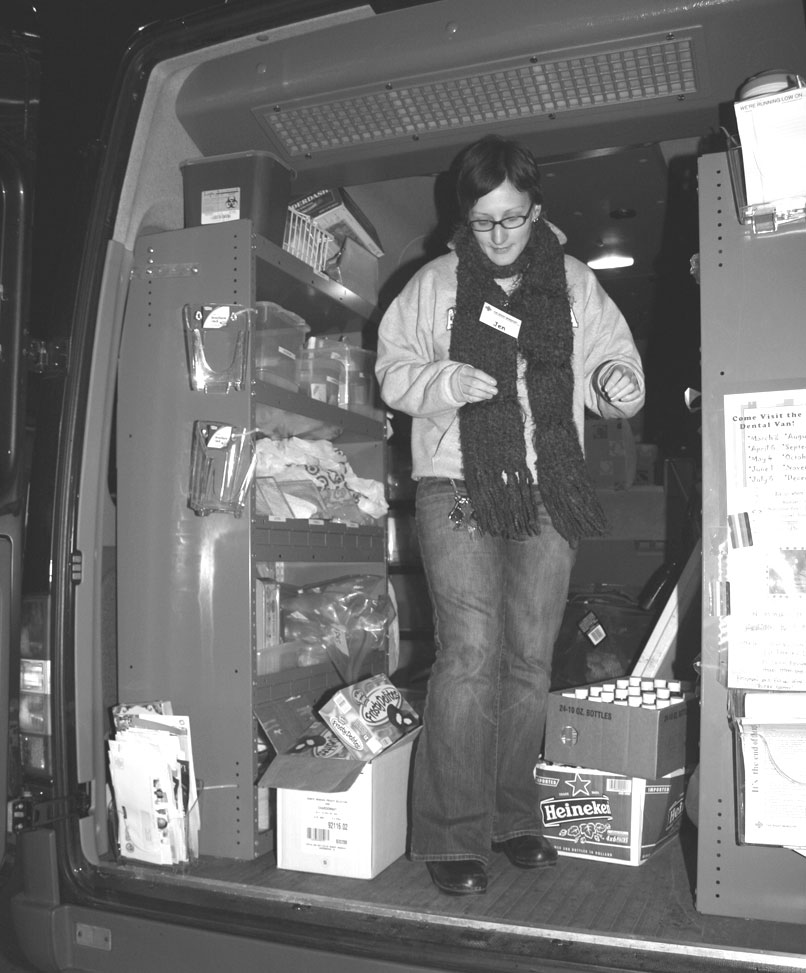
Jen Rude, a youth outreach professional with The Night Ministry, at a recent youth street outreach event in Lakeview.

_______________

Homeless LGBT youth face increased difficulties compared to their heterosexual counterparts both on the streets and within the shelter system, according to a study the National Gay and Lesbian Task Force report, “Lesbian, Gay, Bisexual and Transgender Youth: An Epidemic of Homelessness,” which was released in January 2007.

According to the report, LGBT homeless youth are more vulnerable to mental health issues, substance abuse, risky sexual behavior and victimization. The report states, “A study of homeless youth in Canada found that those who identify as LGBT were three times as likely to participate in survival sex than their heterosexual peers,” and The National Runaway Switchboard reported, “LGBT homeless youth are seven times more likely than their heterosexual peers to be victims of crime.”

Shelter systems do not ease many of these risks for LGBT teens. “The majority of existing shelters and other care systems are not providing safe and effective services to LGBT homeless youth,” the report states.

For trans youth the barriers increase. “Transgender youth are disproportionately represented in the homeless population. More generally, some reports indicate that one in five transgender individuals need or are at risk of needing homeless shelter assistance. However, most shelters are segregated by birth sex, regardless of the individuals gender identity, and homeless transgender youth are even ostracized by some agencies that serve their LGB peers,” according to the document.

Trans youth experience and fear violence, harassment and discrimination within the shelters and, for many, staying in a shelter can be less safe than spending the night on the street.

Over the past few years, individuals working with homeless youth in Chicago note several positive changes for LGB teens, as more shelters work to understand the complex issues facing these youth; however, trans youth are still experiencing disturbing difficulties. . . .

A first: Transgender turns TV host

By HT
Friday November 2, 12:44 AM

SHE WALKED into the hall with the grace of a film star, apologising for the delay. But Rose, even before the opening of her first TV show, is already a star. She will be the first transgender to host a show on Indian television.

The 28-year-old from Chennai will be hosting Ippadikku Rose (Yours, Rose), a weekly programme, from December. The show on Star Vijay, a popular Tamil channel, will discuss social issues that are taboo - like her misunderstood sexuality. An engineering graduate with two Masters degrees from a US university, Rose was born a boy. "I used my male identity to complete my education and only three years ago I announced 'my coming out' as a transgender," she told a crowded press meet on Thursday.

Articulate in English and Tamil, Rose hopes her show will convey the correct picture about transgenders, most of whom have been forced into begging or becoming sex workers by a society that shuns or ridicules them. "Even today there is a misapprehension that trangenders are born with deformed genitals. We are like normal human beings except that we are females trapped in male bodies or vice-versa," said Rose.

Most films or TV programmes only depict trransgenders as objects of ridicule and cheap humour. "If my emerging as the first transgender star helps my community to change this image, I'll be happy." Rose's family, who rejected her when she "came out", have now accepted her, grudgingly.

Rose is a web designer and is associated with the "NGO industry" on issues like HIV/AIDS and transgenders. "Since we will not have families, all I need is food, clothes and decent place to sleep."

Dr Jaya Shreedhar, a popular writer on HIV/AIDS, said: "I am certain Rose will be a fabulous TV personality who will bring a greater openness to sexuality in our society." Pradeep Milroy Peter, programme head of Star Vijay, said an institute that trains social workers introduced Rose to the channel. "As soon as Rose got talking about what she wanted to do, we knew we had a new star. True, the novelty of the programming is a transgender hosting it, but the focus will be to bring into the open issues hushed up by society."

Wednesday, October 31, 2007

Early Dressing Experiences

Savage Love: Letters

by Dan Savage


There are times when I suspect you give an outrageous response to a reader so you can get a free column out of the angry responses.

Regarding your response to Auntie Mame about the femmy 5-year-old nephew, I think calling his father’s reaction emotional abuse is completely over the top. Restrictive and unfair? You better believe it. But abuse? Nothing in her letter leads me think the kid would get pulled from his home by a social worker.

If the dad were abusing the kid, he’d be in his face calling him a sissy and a namby-pamby or whatever, and making him sit in a dark room. Or making him eat dog shit to make a man out of him (see the bookTen Points by Bill Strickland). Leave the term “abuse” for those who deserve it.

Iowan Dissenter


I just wanted to commend you on the superb advice you gave the lady who’s worried about hiding her nephew’s homosexuality from her brother. My son is exactly like the little guy described, and apart from making me sit throughHigh School Musical 2 instead of father-and-son rugby games, I couldn’t love him more. It saddens me that there are parents who set themselves and their kids up for the most astonishing amount of heartache by denying a kid’s sexuality.


All Power to Auntie Mame


“Auntie Mame” has a 5-year-old nephew who likes to play dress-up in girl’s clothes, and the father has forbidden him from doing so. You wrote that there’s “a 100 percent chance that your brother will one day regret his actions,” and even to tell the nephew that his father “will come around one day.”

I’ve got to call 100 percent bullshit on you. In fact, I’m sort of forced to wonder what planet you’ve been living on recently. I was also caught cross-dressing by my parents at about the same age—and their displeasure was clearly communicated to me, and I dropped it for the rest of the time I lived with them (mostly). We’ve never discussed it since—I’m now in my late 30s—and there’s no way in hell my parents are going to “one day regret their actions/come around.” Late in high school I was told that the one thing that would get me disowned would be to “run off with” my male best friend at the time.

Is my life destroyed? No, I really don’t think so. Perhaps screwed up a bit—I couldn’t even call this “emotional violence,” frankly, just a big difference in taste.

But at any rate,please don’t get the hopes up of Auntie Mame and her nephew in such an unrealistic fashion. Waiting for an acceptance that never comes may be far more hurtful, on an ongoing basis, than just accepting that your father and you don’t like all the same things.

Been There, Done That


While I don’t disagree with the advice you gave Auntie Mame—be supportive and prepare to provide more emotional and physical support—I wonder if the nephew in question isn’t experiencing more of a gender-identity challenge than one of sexual orientation. Yes, there’s the whole “Zac Efron is cute” thing, but what the heck does that mean when you’re 5?

As a breeder female, I chose at that age to play with the boys because they had trucks, and got dirty, and mixed up weird botanical crap found in the back yard and dared you to eat it. That was cool. Although I identify as female, I was drawn to the power of male environments. Perhaps young nephew isn’t even gender-identity challenged—he just likes the really fun—and powerful—parts about being a girl.

Plenty of self-respecting gay men never thought of putting on makeup and dancing to show tunes. Many have. Many females have never been enticed by silly boy shit. Many have. How ’bout we add the advice of not making assumptions about our young nephew while providing a safe space in which he can work it out for himself?

HFP


I was delighted to see Auntie Mame’s letter today, because I’ve been wondering for two years whether my 6-year-old son might be gay. It’s fine with me whatever his sexual orientation is, but one wants to know, and to be aware of who your children really are so you can be sure to parent them the right way. And I think the last thing you want, no matter what age your kids are, is toask them these things, especially when they’re sweet and shy and sensitive. You just want the conversation comfortable so they can tell you things.

Anyhow, two years ago he started asking whether men can marry men (I tell him people can marry whomever they love), and pointing out that “boys are much prettier than girls.” He’s sweet, shy, gentle and musical, and loves to paint his nails and dress up. He once asked wistfully if YouTube had any videos of “two men mating” (I assured him it didn’t).

This is all fine, and not a parenting challenge, and he’ll grow up to be darling whatever his sexual orientation is. But what has surprised me is the number of our liberal, open-minded, non-homophobic friends whose reaction when we would mention this is that “no one could possibly know at age 5 what their sexual orientation could be.” That seems wrong to me. You don’t have to know anything about sex, or to want to have it yet, to know what kind of person you are interested in. I knew perfectly well at age 4 that I was a princess and that I would marry a prince, and that princes were in some way attractive, even if I wanted nothing to do with them in real life.

Love My Son


I love your column, and think that 99 percent of the time, you are bang on, primarily because you recommend honesty and communication. However, this time I think you really blew it, primarily because you recommended dishonesty and subterfuge.

You were right on when you said the homophobic father was endangering his relationship with his son. As I once said to a homophobic mother: “Your attitude toward your son is never going to make him sorry that he’s gay. It’s only going to make him sorry that you’re his mother.”

However, you advised Auntie Mame to do the gay stuff with little Johnny on the sly. There we part ways. It’s not addressing the real problem, which is the father’s, not the boy’s. He’s learning at a young age to disrespect his father (who, I know, already disrespects Johnny), to do things on the sly (shades of Larry Craig), to not trust his father, to find an adult who will indulge him (manipulation), to lie, and worst of all, to bein the closet about who he is.

It’s all going to come out anyway—what 5-year-old can keep a secret, or even understand that one must be kept? Johnny will be punished, and probably the worst thing, Auntie Mame will be denied access, and then that little boy will have no one in his life to support him.

Better for Auntie Mame to bravely tell Daddy the damage he may be doing to his son and to his relationship with his son, and offer to pay for a few visits to a therapist for Daddy. Communication is what’s necessary here, not ideology or self-righteousness. A little boy’s future is at stake.

Ben J.


Auntie Mame and you both are making an assumption that is likely wrong. Lets go over the evidence: The young nephew likes “putting on makeup, watching and dancing along to musicals with vampy women (likeChicago), (and) playing dress-up.” This doesn’t sound so much like the child is gay, but rather that he’s possibly (male to female) transgendered. I should know because I am myself.

If instead of a nephew doing these things it was a niece, no one would mind or give it a second look. Assuming someone is gay and not possibly transgendered when in fact they are transgendered can cause just as much harm as assuming they’re straight when in fact they’re gay.

Having had my say, I will agree with your overall advice regarding the letter writer to be supportive and how to deal with the dad. Ideally all parents will let their children grow up to be whoever they will be free of preconceptions.

TGIRL


Transgender Rights Are A Worldwide Struggle

by Monica Roberts

One of the things I've noticed over the last few years is how transpeople all over the world are gathering the courage to stand up, proudly proclaim their pride in who we are and fight for our human rights to be respected. The battle over ENDA in the United States is just one front in this struggle to not only gain recognition and respect but to be able to openly and honestly live our lives.

As a transgender person, my brothers and sisters are everywhere. I am not limited to the borders of the United States or my ancestral home continent of Africa in this regard. Any success that we as transpeople have somewhere on planet Earth affects me positively. I also share the pain and disappointment when I hear about the violence and repression faced by transpeople in many parts of Africa, Central America, South America, Jamaica and the United States or the legal setbacks in various countries when it comes to transgender issues.

I cheered when Israel's Dana International won the Eurovision song contest. I'm envious of my sisters in Thailand who get to transition early without the faith-based hatred that we face here in the States. I marvel at the beauty of the transwomen from Mexico, the Philippines, South Korea, Japan and other parts of the globe. I was moved to tears when Georgina Beyer became the first transwoman ever elected to a national legislative body as a member of New Zealand's parliament. I was happy to see that then 12 year old Kim in Germany was allowed to transition and is now happily growing up as a teen aged girl. I'm thrilled by the victories that Spanish transpeople gained in terms of their name change rights. I was fascinated to discover that transpeople even exist in Iran and other parts of the Middle East.

I jumped for joy when the Gender Recognition Act of 2004 was passed by the British Parliament. The recent Irish case allowing a transwoman there to change birth documents will hopefully help us here in the States.

Some of my early role models when I was growing up in the 70's were international in scope such as Britain's Caroline Cossey. I'm inspired to fight harder for my rights here in the States by drawing on the examples of courage from Ugandan Victor Juliet Mukasa , the Queen of Africa and transactivists in Argentina.

And my thoughts are reciprocated in other parts of the world as well. The upcoming Transgender Day of Remembrance started here in the States but has quickly become a worldwide event. I was pleased to discover that my blog is read internationally when I noted that Portugal's Eduarda Santos links her transgender blog to various posts of mine on occasion. I hope that you international readers are enjoying getting to learn about what life is like for a transgender person who also happens to be an American proud of her African roots.

I'm delighted to see that transgender pageants are exploding in popularity in the Philippines, Thailand and Great Britain and that our transpeeps in South Korea, thanks to Harisu, can not only get their name changes done but get married as well.

Even China has an emerging transgender community with Chen Lili as its poster girl. And like Georgina Beyer, more transpeople are getting elected to public office in various countries, including my own.

We are all interconnected. Transpeople know this lesson better than anyone. Just look at how SRS technology advanced. It was an international effort and we traveled to wherever it was available.

In 1952 the late Christine Jorgenson got her pioneering surgery done in Denmark. Others later flocked to Morocco in the 1960s to get the updated techniques from Dr. Georges Burou that modern SRS is based on. The late Dr. Stanley Biber of Trinidad, CO built upon and perfected it during the 70's and 80's. Montreal surgeons Dr. Yvon Menard and Dr. Pierre Brassard built on that work and Dr. Michel Seghers was doing cutting edge SRS surgeries as well in Belgium. Now transpeople flock to Thailand from all over the world to take advantage of the reasonably-priced cutting edge work of the Thai doctors to get it done.

The civil rights struggle, like the medical advances in SRS techniques is an international one as well. We may feel in our various countries from time to time that we're fighting it alone, but we aren't.

But the fight is an ongoing one. Just as we have religious zealots in the United States seeking to retard our progress, so do our brothers and sisters around the world. Islamic fundamentalists are opposing our sisters in Malaysia and Indonesia. Nigerians have the double whammy of being opposed by Islamic and Christian fundamentalists.

Like the US Republican party, there are politicians pandering to the bigot vote like Prime Minster John Howard of Australia and our transsisters are caught in the crossfire. The Catholic Church has moved from an affirming position on transgender issues to an increasingly intolerant one under Pope Benedict XVI. Our sisters in the Philippines have recently suffered a blow from their Supreme Court in terms of being able to change their birth documents.

As former South African president Nelson Mandela so eloquently stated, 'the people are their own liberators.'

We must take his words to heart and act as our own liberators. We must continue to support each other, reach out to supportive family members and friends, win allies, pool information, strategies, tactics and information so that we reach our ultimate goal: respect of our humanity.

We transpeople should never give up hope. We must continue to fight to have our basic human rights in our various homelands respected and protected. That must happen if we wish to contribute our talents to help build our communities and our respective nations. We must be able to work without being harassed or denied employment we are qualified for. We mush be able to live quality lives without having fear, shame, guilt and the specter of violence heaped upon us. We must be able to freely use our talents to accomplish whatever we set our minds to do and have the faith to believe that one day we will prevail over the Forces of Intolerance.

And yes, I believe this will happen in my lifetime. . . .

Transsexual women

By Belinda A. Aquino

HONOLULU -- This is not an easy piece to write. It’s probably the most unusual and unprecedented case the Philippine Supreme Court has had to deal with in its history. It will be many, many years before the high court can have some kind of “transgender law” to guide its future deliberations on transgender cases.

The Court recently denied the petition of Rommel Jacinto Dantes Silverio, a transsexual, to change the entries in his birth certificate in the Office of the Civil Registrar -- specifically, his gender from male to female and his first name to “Mely.” This despite the fact that Silverio had undergone what is technically called a “sex-reassignment surgery” in Bangkok in 2001 to become a biological woman. The Court, however, ruled that while the petitioner “may have succeeded in altering his body and appearance through the intervention of modern surgery, no law authorizes the change of entry as to sex in the civil registry for that reason. There is no special law in the country governing sex reassignment and its effect. This is fatal to petitioner’s case.” The Court concluded that it is up to Congress, if it chooses, “to determine what guidelines should govern the recognition of the effects of sex reassignment.”

The riveting story of Rommel/Mely Silverio is detailed in an intimate Internet account titled “My Life as a Transsexual Woman,” which he/she divides into: (1) pre-gender transition from birth to 1995; (2) pre-surgery days in Hawaii from 1996 to 2000; and (3) post-surgery life in the Philippines from 2001 to the present.

It was as a doctoral student in Sociology at the University of Hawaii at Manoa that I came to know Rommel very well. His late mother Anita I knew back in Manila. He was all of 230 pounds but over time I could notice a gradual change in his appearance. He had embarked on a regimen of female hormone pills and estrogen shots. I teasingly told him one day that he was becoming “sexy” but to be “careful.” By the end of 1996, he had already lost 50 pounds. He continued the routine until he lost another 30 pounds. So by now, he was down to 155 pounds evenly distributed in his 5’8” frame. He was becoming a woman and gaining a “greater sense of self-esteem and confidence.”

He went on to defend his dissertation on youth sexual behavior in 2000, and had acquired a “boyfriend” who consented to have him go to Bangkok for the sex change. For about three hours, a renowned Thai surgeon performed vaginoplasty and breast augmentation, increasing her breast size from A to D. Her recovery and post-surgery therapy lasted 18 months, after which she introduced her boyfriend, the man she was going to marry, to her family.

While Rommel had become Mely, for which she was ecstatic, several problems arose. The name on her passport was that of a man and inspectors couldn’t reconcile this with the tall, svelte and well-dressed woman standing in front of them. She had to have two sets of documentation all the time to attest to the fact that Rommel and Mely were one and the same. Bank personnel would do all sorts of checking, so she would seek out only those that already knew her to avoid any confusion and embarrassment. And so on. She could have easily come back to the United States where she wouldn’t have these hassles.

But discriminatory comments such as that the Philippines is not ready for transsexual women like her only increased her resolve to be treated equally and justly. Such remarks only “added fuel to my desire to be regarded as a professional colleague, to be treated with respect as a woman, and to be given a fair chance at life in general.” She escalated her personal struggle to attain “full legal recognition as a woman here in the Philippines, my country of birth” by petitioning the courts to change her gender and first name. The Court of Appeals denied her petition, which was a devastating blow. I am certain that the Supreme Court verdict upholding the lower court was even more devastating.

So, what now? I have great compassion for Mely -- whom I will always remember as Rommel -- who is really a very bright and likable individual. What does it matter really -- Rommel or Mely, man or woman -- it’s the same human being! And she has gone through the whole process with extreme pain of validating the essence of her identity and humanity. What more can we ask? But the law as they say is cruel, but it’s the law.

As a footnote, the large majority of transsexual (TS) transitions work out very well over the long term as documented in Lynn’s “Transsexual Women’s Successes.” However, in some cases, complete TS transitions “fail to meet very unrealistic expectations, and way too late the transitioner may realize that undergoing sex reassignment surgery (SRS) was a BIG mistake.” Among the “regretters” is Renee Richards, who was born a male but transitioned as a female via surgery in 1975 at age 40 and became a famous tennis player. She wished she had not done it, but too late. She realized she would always be seen as a transsexual and never as a real woman that she had earlier hoped to become.

My only hope for Rommel/Mely is that she won’t regret the biggest decision she made in her life, and that society will become increasingly tolerant, if not accepting, of diversity in all its possible senses and meanings.

Belinda A. Aquino is director of Philippine Studies at the University of Hawaii at Manoa, where she has been professor of Political Science and Asian Studies.

Over One-third Of Former American Football Players Had Sexual Relations With Men, Study Claims

ScienceDaily (Oct. 30, 2007)A study of former high-school American Football players has found that more than a third said they had had sexual relations with other men.

In his study of homosexuality among sportsmen in the US, sociologist Dr Eric Anderson found that 19 in a sample of 47 had taken part in acts intended to sexually arouse other men, ranging from kissing to mutual masturbation and oral sex.

The 47 men, aged 18-23, were all American Football players who previously played at the high school (secondary school) level but had failed to be picked for their university’s team and were now cheerleaders instead. They were at various universities from the American south, Mid-West, west and north west.

Dr Anderson, now of the University of Bath, UK, said the study showed that society’s increasing open-mindedness about homosexuality and decreasing stigma concerning sexual activity with other men had allowed sportsmen to speak more openly about these sexual activities. He found that this sex came in the form of two men and one woman, as well as just two men alone.

He said that the sexual acts described differed from acts of ‘hazing’ or team-bonding that often include pretend-homosexual acts.

“The evidence supports my assertion that homophobia is on the rapid decline among male teamsport athletes in North America at all levels of play,” he writes in his study, entitled ‘Being masculine is not about whom you sleep with…Heterosexual athletes contesting masculinity and the one-time rule of homosexuality’. It will be published in the journal Sex Roles in January. . . .

Either way, "Miriam" an awful dating show

Tue Oct 30, 2007

There's Something About Miriam , 10 p.m., Fox Reality Channel)

LOS ANGELES (Hollywood Reporter) - Yes, there is something about Miriam, all right. She's a guy. Or, well, a pre-op transsexual, anyway. Welcome to "The Crying Game: The TV Series."

Six strapping heterosexual British dudes. One stunning Latin model. A mansion in Ibiza. The guys compete in this "reality" dating show to be the one who gets to go on a weeklong yacht cruise with Miriam and pick up 10,000 pounds ($20,670) in the bargain. What they don't know, of course, is that she is in one very important area actually a he.

Fox Reality Channel snatches this show whole from the U.K., where it's said to have been a controversial hit nearly four years ago under the title "Find Me a Man." The suitors here don't become privy to their prize's true anatomical nature until near the end of their quest, which is simply cruel. Miriam offers that she is into "straight guys," so it's no wonder she has been so frustrated in her search for Mr. Right to this point. That penis thing keeps getting in the way.

The contestants here engage in various physical challenges -- under the direction of a genuine no-nonsense drill instructor -- to impress the object of their affection. Previews from upcoming episodes confirm that there is early speculation about Miriam's gender among the lads. It's undeniable that Miriam, who was 21 at the time, is beautiful. But it's also obvious that she is pretty dim, making her an appropriate subject for this pointless piece of exploitation. . . .

Tuesday, October 30, 2007

Donna Rose - Our Stories, Our Selves


Contact: Donna Rose

Two former men share transgender experience

Diana Bubser


October 31, 2007

Transgender activists Barbara "Babs" Casbar and Terry McCorkell spoke to a crowd of about 30 College students Thursday night in Forcina Hall to address the historical, political and social issues of transgender advocacy. They also shared their own gender identity experiences: the two former men now each lead the life of a woman.

"This room is a pronoun-free zone," McCorkell declared.

The lecture was presented by PRISM, the College's organization supporting the equality of gays, lesbians, bisexuals and transgender people.

"We are always looking to educate ourselves and others," Angel Hernandez, president of PRISM, said.

Wearing a multicolored dress and flashy jewelry, McCorkell spoke of her teenage years, when she was not only interested in girls, but wanted to be one. However, she waited until her 30s to join transgender support groups and start communicating with others about the issue.

The work McCorkell did in the 1990s laid the foundations for New Jersey Laws against Discrimination, and she was honored by then-Sen. Jon S. Corzine as "Activist of the Year."

"I used to be shy as a man, but learned to be assertive as a woman," she said.

Casbar referred to herself as a "woman scarred by many years of testosterone." After her wife died, she realized she was a "lower-class citizen." Instead of crying, she decided to take action.

Casbar is now the head of the Gender Rights Advocacy Association of New Jersey and serves on the boards of Garden State Equality and New Jersey Stonewall Democrats.

A PowerPoint presentation was then shown explaining the difference between sexual orientation and gender identity.

"Sexual orientation is who you are attracted to, while gender identity is who you identify with," it said.

McCorkell feels New Jersey is the "most knowledgeable on gender discrimination" of all the states. However, she also points out that transgender acceptance is not nationwide. . . .

Reform Jewish Leader Calls on House to Pass Transgender Inclusive Non-Discrimination Act

Saperstein: The right to earn a living without fear of discrimination ought to be extended to all Americans, regardless of sexual orientation or gender identity.

Contact: Sean Thibault or Kate Bigam
202.387.2800 | news@rac.org

Washington, D.C. October 29, 2007 — In anticipation of this week’s House vote on the Employment Non-Discrimination Act, Rabbi David Saperstein, Director of the Religious Action Center of Reform Judaism, issued the following statement:

We are pleased by the House’s planned vote later this week on the Employment Non-Discrimination Act, legislation that will provide long-overdue protection to gay and lesbian Americans at risk of workplace discrimination based on their sexual orientation. The right to earn a living without fear of discrimination ought to be extended to all Americans, regardless of sexual orientation or gender identity. Yet in 31 states, it is legal to fire, demote, or fail to promote an employee based on sexual orientation; in 39 states, it is legal to do so based on gender identity.

That is why it is essential that the House also pass an amendment to be offered by Rep. Tammy Baldwin (D-WI), which will add gender identity protections to the bill. Extending workplace protections to the entire gay, lesbian, bisexual and transgender community bolsters the moral power of this legislation.

Throughout our nation’s history, our leaders have had to make many tough decisions about issues of justice and morality. Rarely have these decisions been easy. As Reform Jews, we are guided by Jewish tradition and text that teaches us that all human beings are created b'tselem Elohim, in the Divine image. Our nation’s sacred texts also guide us, as well as Americans of all faiths and no faith, reminding us that we are all created equal. We look forward to working with members of Congress in support of legislation that achieves that goal.

###

The Religious Action Center of Reform Judaism is the
Washington office of the Union for Reform Judaism, whose more
than 900 congregations across North America encompass 1.5 million Reform Jews, and the Central Conference of American Rabbis, whose membership
includes more than 1800 Reform rabbis

India: Depicting the transgender truth


Shai Venkatraman

Tuesday, October 30, 2007: (Mumbai):

It's a community most people ridicule or prefer to keep at arm's length.

But what does it mean to cross the gender divide, to be free of being male as society defines it?

That's the theme explored in the film Our Family.

A true story about a family of transgender women that unfolds over three generations.

The film's set in Tamil Nadu and tells the story of Aasha, Seetha and Dhana, who are bound together by ties of adoption.

Aasha is the grandmother, Seetha her adopted daughter and Dhana who is adopted by Seetha and her partner Selvam.

"We wanted to make a film which would question the way people look at the hijras. We wanted to look at the human rights violation, the stigmas and also look at the warmth and celebratory aspect of it," said Dr Anjali Monteiro, Filmmaker.

The film documents their journey as they discover their sexual identities and progressively blur the lines between themselves and what's seen as normal social behaviour.

"They become a regular family. So the woman Seetha does the cooking. She does assert herself but in trying to do so she asserts her womanly identity even more, one of the things that struck us was that they were normal but in trying to be normal they had to play out the politics of being normal in some sense," said K Jayanshanker, Filmmaker.

The film will not release commercially and will remain limited to the festival circuit. Clearly that's one barrier that will take some time crossing. . . .

Stereotypes under fire

When Knoll Larkin was coming out, he said he thought everyone smoked.

Smoking seemed to be accepted as a part of the bar culture that historically provided the lesbian, gay, bisexual and transgender community with a safe haven, said Larkin, health services coordinator for Affirmations, an LGBT community center in Ferndale, Mich.

These perceived high smoking rates inspired Affirmations to collect information on the number of actual smokers in the LGBT community and gather their views on the health, social and economic aspects involved with smoking.

It also prompted their support for a Michigan bill that would ban smoking in places of employment, such as bars and restaurants.

Affirmations’ study — using information compiled in 2006 — revealed that 53 percent of the more than 350 people surveyed were past or current smokers, 33 percent of which identified as current smokers.

The average age of survey respondents was 35, with a range of 16 to 66. Most respondents, 76 percent, identified as gay or lesbian, 14 percent identified as bisexual and 2 percent identified as heterosexual, according to the study.

Contributing factors to smoking for LGBT people include heightened stress levels, increased incidence of substance use, reduced access to health care and targeted marketing by the tobacco industry, according to the study.

Mandi Rabe, a member of People Respecting the Individuality of Students at MSU, or PRISM, said she doesn’t see the LGBT community as being affected by smoking more than any other population.

“I think it’s still a stereotype that the queer population does more drugs,” said Rabe, a political theory and constitutional democracy sophomore. “With my own involvement in the community, I don’t see it any more. Clearly out of all the stereotypes, it’s one of the least worrisome — but it’s still something that needs to be dealt with.”

According to the American Cancer Society, more than 30,000 LGBT people die from tobacco-related diseases each year.

Smoking also increases the risk of blood clots in transgender women who take estrogen, and heart disease in transgender men who take testosterone, according to the National Coalition for LGBT Health.

David Jaques, president of Respecting Individuals on Neutral Grounds, or RING, said the number of LGBT and heterosexual smokers seems to be proportionate.

“It’s like saying gay people ride more bikes than straight people — there’s not a correlation in my mind,” he said.

The difference in generations also should be taken into account, Jaques said. Older people seem to smoke more than younger people, he said.

Jaques, who said he doesn’t go to bars or clubs very often, said banning smoking would only make it more enjoyable to go out. . . .

Methodists Vote to Keep Transgender Pastor


Video by Pauline Bartolone

In a potentially landmark decision, the United Methodist Church has ruled that a transgender pastor who applied for a name change can remain in the ministry. The decision in case of the Rev. Drew Phoenix was released on Tuesday by the church's Judicial Council.

The United Methodist Church, or UMC, bans gay people from serving as clergy, but its Book of Discipline makes no mention of transsexual people. "Essentially, they said that I'm a pastor in good standing and therefore I'm appointable," says Phoenix, who leads St. John's in Baltimore.

In affirming Phoenix as an ordained minister, the council left aside the specific question of whether transgender people can serve. What mattered here was that Phoenix faced no "administrative or judicial action" beyond the question of the name change itself. "The Judicial Council does not reach the question of whether gender change is a chargeable offense or violates minimum standards established by the General Conference," council members wrote.

Phoenix says he always felt male. As a girl, the Methodist minister says, he was known as "Dave Gordon's son." Even when he was preaching as Ann Gordon, Phoenix says, people related to the pastor as a man. But it wasn't until last year, at the age of 47, that Gordon decided to undergo surgery and hormone therapy -- to formally become male.

After the then-Rev. Gordon was reappointed as Drew Phoenix at the Baltimore-Washington Methodist Conference in May, members of the UMC petitioned to ban transsexuals from serving. Now, with the Judicial Council's ruling, Phoenix plans to continue at his church.

Phoenix says he knows he's something of a test case, but calls his transition a gift to the church. The ruling "is outstanding," he says. "It's historic."

UMC members have been wrestling with issues of gender and sexuality, as have other branches of the wider Protestant church. The Phoenix case was one of several on the Judicial Council docket that dealt with such matters, including one from northern Illinois for an initiative called "Affirming All Familes" and another from the California-Nevada conference about plans to "Welcome and Include LGBT" people in church leadership.

The church could take up the issue of transgender clergy again at its general conference in April. Questions concerning sexual minorities have become regular a feature of national UMC gatherings. "It has come up at every general conference in recent years," says spokesperson Diane Denton, "so I would expect it would be an issue again."