
Friday, October 27, 2006
Sharpen Your Observational Skills
A person exploring a different gender role gives up certain ways of behaving and replaces those old forms of action with new behavior. Learning to blend with other women or men requires that you learn to BECOME A GOOD OBSERVER of the various ways people appear and behave in different situations. Hence, SHARPENING YOUR OBSERVATIONAL SKILLS, especially seeing and listening, may prove very helpful as you modify your gender role. Observing the appearance and behavior of others will provide you with a variety of looks and behaviors from which you can construct and practice the person you wish to be. What you see and hear, in combination with your own creative talents, will enable you to put together a nearly endless variety of possibilities that you'll be able to test until you find something that feels comfortable and works for you. As you make progress your awareness of who you are and what you can do will deepen. You'll learn to creatively copy parts of what you see or hear and then put those parts together to compose something new.
In the beginning, keep things simple and uncomplicated, work on matching or approximating the basics. Go slow. For example, you might focus on blending with others who have your same general characteristics, for example, age, hair and eye color, height and weight, and so on. As you become more comfortable and confident in your chosen role you may wish to become more adventurous and experimental. Don't rush things, change a step at a time. You'll gradually develop a style that fits and feels comfortable. Remember the foundation for this change process is developing good OBSERVATIONAL SKILLS. This will include learning to observe others and learning to observe yourself. Become a good observer of differences in verbal and facial expressions, hand and arm movements, body posture and walk. Observe people as you go through your daily activities, while watching television and films, and listening to the radio. Try observing the nonverbal behavior of television personalities with the audio off or look away and turn the video off and listen to the audio portion alone. Observe the behavior of people in airports and shopping malls. What differences in the behavior of women and men do you see or hear? How do the two genders handle similar situations?
A second part of learning to blend and feel comfortable in your environment is learning to sift and sort the information obtained from observing. You'll want to separate your observations into those things that will work for you, and those things that won't work, or, may even, alas, make your life more difficult. This sifting and sorting is not an easy task but rather something that only comes with practice and a willingness to experiment, evaluate, and make use of feedback from others.
In addition, you may want to consult various books for specific information or even image specialists or coaches who work with color, style, cosmetics, walk and posture, and voice. However, after you learn what you can from observing people and their behavior you'll still need to regularly PRACTICE WHAT YOU'VE LEARNED EVERY DAY. Approach change actively. In the early stages of transition this will mean FOCUSING ON BEING AWARE OF YOUR BEHAVIOR and what is needed to blend comfortably, and then practicing it, and doing it again and again. If something you do doesn't work, don't do it again. Do something different.
In contrast, PROMPTLY SAY GOOD THINGS TO YOURSELF AS YOU HAVE POSITIVE EXPERIENCES. Learn to regularly GIVE YOURSELF COMPLIMENTS as you make progress. This immediate personal recognition of your progress is very important and cannot be under emphasized. KEEP THE CRITICAL REMARKS YOU MAKE ON YOUR BEHAVIOR TO A MINIMUM. The variety of social situations you encounter will each require something somewhat different. Be flexible and DO NEW THINGS. Let go of any actions, thoughts, and feelings that block your progress.
This is the time to be playful, to pretend, to relax and experiment. Summon your acting skills and recall the playful, creative times of childhood. You'll find yourself becoming more flexible, innovative, and varied as time and experience builds. Just as learning to ride a bicycle was once a very conscious, planned, step-by-step activity that eventually became fluid and automatic, so will the expression of your preferred gender role become. Practice your observational skills. Change, and discover what works for you.
Some Questions You May Answer By Observing Others:
1) What are the differences that distinguish the way men and woman walk? Do men and women of the same approximate size tend to walk about the same speed?
2) Do two women walking together tend to walk differently than a man and a woman walking together? If so, in what ways?
3) Is a woman's posture, body position, orientation, etc. different from that of a man while sitting at a table having coffee or a meal? When with a man? When with another woman? When alone?
4) Do men generally make more or less eye contact with the person they are talking to? Are there differences in eye contact when speaking as compared to listening? How about women?
5) Do women and men tend to smile equally frequently during casual conversation? While conducting business?
6) What are the differences in the ways women and men position their arms when sitting? How about their hands? And their legs?
7) How do men and women differ in the ways they tend to position their bodies in chairs or on sofas?
8) If pitch alone is not as important as some people might believe in differentiating a woman's from a man's voice then what speech characteristics are especially important?
9) Do women or men drivers tend to look around more while waiting at a stoplight in a car? Are there age, social class, or ethnic differences?
10) Are there differences between the ways men and women move their eyes and mouths during conversation?
11) Do women and men differ in the ways they stand and leave from a seated position? How about initiating a seated position?
12) If a woman touches her nose when with another person or during a conversation in what ways is she likely to do so? How does a man touch his nose?
13) What are some ways in which men and women use their hands to express themselves during conversations?
14) Are men or women more likely to touch their hair when in the presence of another? How does their touching differ?
15) Do women and men differ in the way they clap? Sneeze? Laugh? Cough?
16) How is a women likely to hold a phone? Is it the same as a man?
17) Are there any differences in the way a woman walks when wearing slacks as compared to a skirt or dress?
18) Do women and men stand at a curb differently while waiting to cross the street?
19) When listening during a conversation are men as likely to nod their heads as women? When does a women nod her head? A man? How do head nods differ for the two genders?
20) How does a man wave good-bye? A woman? How do women and men say hello?
21) Are there differences in the ways men and women terminate phone conversations? Casual conversations? Business conversations? How about opening telephone conversations?
22) How do the ways a woman uses a tissue or handkerchief while in the presence of another person differ from that of a man?
23) Does a woman position her hands on the steering wheel the same as a man while driving a car? While at a stoplight?
24) Are woman as inclined as men to place their hands in their pockets? Under what circumstances?
25) Estimate the percentage of women between the ages of 20 and 30 who wear mini skirts. Between 30 and 40? Between 40 and 50? Over 50? Answer the same question for people wearing shorts.
26) Is the behavior of a woman more like a man's in a formal business setting? How about a casual social situation with business associates, or at a party?
27) Are men or women more likely to lean forward while engaged in conversation?
28) What are some conversational strategies or devices by which women seek to build cooperation and community? Do men generally have similar styles?
29) How do women and men differ in being verbally competitive? Are both genders likely to behave the same when competing, expressing differences in opinion, asking questions, etc.?
30) Are there differences in the frequency of statements of affirmation or denial as compared to the frequency of asking questions in the daily conversations of men and women?
31) Do women generally dress differently in various parts of the Bay Area, e.g., San Francisco vs Palo Alto, Berkeley vs Concord, etc.? How about men? What are the differences for different communities in your geographical area?
32) What are some age, social class, and ethnic differences in the ways women use cosmetics, style their hair, wear jewelry, etc.? Answer the same question for men.
33) What do the two genders do with their hands while standing and talking to another person? While just standing and looking or waiting?
34) Do women and men look differently when riding bicycles? How do women and men athletes look while riding bicycles? On the street? In competition?
35) Do the two genders differ in the ways they talk to children? Play with children? Discipline children? Teach children?
36) What can you learn about hair styles, makeup, grooming, jewelry, various types of clothing, etc. from observing women and men models in newspaper, magazine, and television ads and catalogs for clothing? How do these various features of a person combine to produce an effect, generate feelings, etc.?
37) Notice the many different approaches women have in wearing jewelry and using makeup. How do you decide if a woman is wearing too much makeup or jewelry? Are there times when a certain amount of jewelry is actually needed?
38) What are the differences between men and women in holding and drinking from a cup or glass? Are women as likely as men to drink directly from a soda or beer bottle in a restaurant? What kind of restaurant? What time of the day?
39) Do women and men differ in the way they eat popcorn, a hamburger, an apple, etc.?
40) Do hair styles and the length of hair for men and women tend to change over a person's life span?
41) What are some topics one is likely to find women discussing with each other in casual conversation? In a business conversation? When with men? Answer the same question for men, when together and when with women.
42) Are there differences between women and men in their tendency to look at other people who are walking toward them from the opposite direction while, for example, walking down a sidewalk or shopping mall?
43) How do women and men express disagreement? Anger? Happiness? Sadness? Joy?
44) Do men or women swing their arms more while walking?
45) Are there differences in pacing, speed, and rhythm in the ways women and men move through their daily activities?
46) What are some differences between the two genders in various forms of touching another person of: a) the same gender, and b) the opposite gender?
47) Are there differences between men and women in teasing others? Who teases whom? Are there differences in arguing? Who argues with whom?
48) Is it true that women speak one way when with other women, another way when engaged in business or professional activities, a third way when with men socially, and still a fourth way when with children? Are there differences for men under similar conditions?
49) Do women tell jokes as often as men? When the two genders tell jokes, in general, do they tell different kinds of jokes, jokes with different themes, etc.?
50) Observe the expressions communicated in the eyes of men and women in various advertisements for clothes, sports equipment, cars, cosmetics, and foods. Notice both expressions depicted in magazine and newspaper ads and television commercials. What differences do you see in warmth, power, softness, aggressiveness, attractiveness, intensity, and various other emotions as suggested by the appearance of peoples' eyes? Also, notice how the expression in a person's eyes and mouth combine to produce a certain look. In those cases involving action notice how the eyes, the brows, and the mouth work together to communicate different emotions and feelings. What other attributes of a person contribute to differences in facial expressions in the two genders?
______________________
Gender role behavior, like music, is a form of language and hence communication. As you sharpen your observational skills you'll learn some of the formal differences in gender roles that exist in this time and place. All women do not behave alike in the same or similar situations. The same, of course, is true for men. This raises an interesting question: What are the appearance and behavior characteristics that define a particular gender role?
Expect your observations to elicit a variety of emotions and feelings. If you're not comfortable with what seems to be rather traditional gender roles you can formulate your own personal, androgynous mix of feminine and masculine behaviors that more comfortably defines who you are. The various possibilities are considerable. Eventually you'll decide what fits for you. You are your personal architect!
Practice your observational skills: Observe others and observe yourself. Be aware of how you walk, talk, and in general behave in different situations. Compare what you say and do to the behavior of other women and men in your area. Everyday pick a couple of the preceding questions to answer and see what you find. What other differences in gender role behavior, not suggested here, do you see as you observe the behavior of various men and women?
Sharpening your observational skills will provide you with information to construct a gender role that feels comfortable and works for you. Hence, you define your gender by the way you appear and behave. Your goal is to develop a presentation that helps rather than hurts you as you change.
Some Interesting Readings:
Brownmiller, Susan. (1984). Femininity. New York: Linden / Simon & Schuster.
Devor, Holly. (1989). Gender Blending: Confronting The Limits of Duality. Bloomington and Indianapolis: Indiana University Press.
Kessler, Suzanne & McKenna, Wendy. (1978). Gender: An Ethnomethodological Approach. New York: John Wiley and Sons.
Lakoff, Robin (1975). Language and Woman's Place. New York: Harper and Row.
Tannen, Deborah (1986). That's Not What I Meant! How Conversational Style Makes or Breaks Relationships. New York: Ballantine Books.
Tannen, Deborah (1990). You Just Don't Understand: Women and Men in Conversation. New York: Ballantine Books.


Tuesday, October 24, 2006

Is DES a factor in the genesis of gender identity?
Click on the title above for the GenderTalk program where Wayne Beyer & Scott Kerlin, doctor and researcher, discuss the impact of DES exposure on male offspring.
The website for the DES-Trans Gender Support Group is at: groups.yahoo.com/group/des-trans. You can join the DES-Trans email group by sending a blank e-mail to: des-trans-subscribe@yahoogroups.com
"DES (diethylstilbestrol) is a synthetic estrogen drug that was given to millions of pregnant women primarily from 1938-1971. Use of DES during pregnancy was thought to prevent miscarriage and ensure a healthy pregnancy. DES did not work, and women who took DES and the children they carried are at risk for certain health problems and may need special care. Find out if you were exposed to DES and if you were, tell your doctor." http://www.desaction.org/what.htm
In addition, see the archives of GenderTalk (link on the right) for other informative and challenging presentations. Highly recommended!
The website for the DES-Trans Gender Support Group is at: groups.yahoo.com/group/des-trans. You can join the DES-Trans email group by sending a blank e-mail to: des-trans-subscribe@yahoogroups.com
"DES (diethylstilbestrol) is a synthetic estrogen drug that was given to millions of pregnant women primarily from 1938-1971. Use of DES during pregnancy was thought to prevent miscarriage and ensure a healthy pregnancy. DES did not work, and women who took DES and the children they carried are at risk for certain health problems and may need special care. Find out if you were exposed to DES and if you were, tell your doctor." http://www.desaction.org/what.htm
In addition, see the archives of GenderTalk (link on the right) for other informative and challenging presentations. Highly recommended!
Sunday, October 22, 2006

"The Transsexual Phenomenon" by Harry Benjamin, M.D.
This seminal major book, published in 1966, helped get health care professionals interested in treating a population of individuals learning they are not alone.
Saturday, October 21, 2006
Friday, October 20, 2006
Wednesday, October 18, 2006

What Do I Want?
1) How do I want to live my life? What do I need to do to be satisfied?
2) What gender expression or role fits for me? How can I tell if my preferred role fits and is the most livable role for me?
3) What are some safe ways to test or explore my preferred gender?
4) Do I want to change my gender role, or can I be happy as a cross dresser (part-time gender role changer), or as a fantasizer?
5) What occupation(s) might enable me to support myself and finance the costs of changing gender roles? Can I change gender expression or role on my present job? How will I support myself if my present job doesn't work out?
6) Do I want to change hormones? What are the pros and cons of hormone therapy?
7) Will my sexuality change as I change, that is, will I be attracted to women, men, both, or neither? Am I mainly attracted to transgender persons?
8) How do I explain my changes to my family and friends? Where can I gain social support?
9) What if changing gender roles doesn't work. Can I go back to where I was before?
10) Do I need to have genital surgery to feel complete? What are the pros and cons of genital reconstruction?
11) Are there some less complicated or less risky ways to deal with my gender issues?
12) How will I know if changing gender expression or role works for me? How do I measure my progress?
Sunday, October 15, 2006

Saturday, October 14, 2006
Answers to Your Questions About Transgender Individuals and Gender Identity
American Psychological Association
Friday, October 13, 2006
Two-Spirit Cultures
"Two-Spirit People, or one called a 'Berdache,' or even one of the 'third gender,' are individuals not caterigorized as either gay or lesbian, transvestite or bisexual. Those who, in many Native American Cultures, who are respected and looked apon as people who are both male and female, making them more complete, more balanced than simply a man or a woman. Before those from Europe came from across the waters, and took over their land, these people were part of the 'norm,' connected with the very heartbeat of the life force we are all part of. Even today, Berdaches are accepted in many American Indian societies and in other settings."
Wednesday, September 27, 2006

I am ME
In all the world, there is no one else exactly like me. There are persons who have some parts like me, but no one adds up exactly like me. I have some parts like others but I don't add up to be exactly like anyone else. Therefore, everything that comes out of me is authentically mine because I alone chose it.
I own everything about me -- my body, including everything it does; my mind, including all its thoughts and ideas; my eyes, including the image of all my eyes behold; my feelings, whatever they may be -- anger, joy, frustration, love, disappointment, excitement; my mouth and all that comes out of it....words, polite, sweet, or rough....correct and incorrect; my voice, loud or soft; and all my actions, whether they be to others or myself.
I own all my triumphs and successes, all my failures and mistakes. I own all my fantasies, my dreams, my hopes, my fears.
Because I own all of me, I can become intimately acquainted with me. Being very well acquainted with me, I can love me and be friendly with me in all my parts.
In being well-acquainted with myself, loving myself, and being friendly with myself, I can then make it possible for all of me to work in my best interests.
I know that there are aspects about myself I do not know, and there are parts of me that puzzle me.
As long as I am friendly and loving to myself, I can courageously and hopefully look for the solution to the puzzles and continually look for ways to find out more about me -- how I look and sound, what I say and do, and how I think and feel.
No one else looks and sounds, says and does, and thinks and feels exactly like me.
However I look and sound, whatever I say and do, and whatever I think and feel at a given moment is me. It is authentic and represents where I am at that moment in time.
When I review later how I looked and sounded, what I said and did, and how I thought and felt, parts may turn out to be unfitting and I can discard that which is unfitting and keep that which proved fitting and learn something new for that which I discarded.
I am me and I am okay.
I own me and therefore I can engineer me.
I can learn all the new things that I need and discard all the things that no longer fit.
I can see, hear, feel, think, say, and do. I will then have the tools to survive, to be close to others, to be productive, and to make sense and order out of the world of people and things outside of me.
I am Me and I AM OK.
~ Virginia M. Satir
Tuesday, September 26, 2006

Passing thoughts on blending for the transgender M to F person
The list, including a dash of humor, was composed by a client I saw in therapy some years ago. I offer it here, in her words, with some minor editing and with her permission:
“The following suggestions may be helpful to you if you get turned off (and not turned on) by being "read" in public settings. If you feel any of these ideas are silly or plain stupid, just sigh deeply and move on to the next one, or propose an alternative way of looking at things.
To begin then:
1. Effective passing is a workable combination of the correct or appropriate behavior and appearance for the situation, i.e., actions, clothing, makeup, etc. Your ability to relax, feel good about yourself, and blend with your environment is especially important. Attitude helps a lot!
A person who sees or meets you for the first time wants to be able to quickly classify you as M or F. If you’re ambiguous or present conflicting cues expect to make people curious and/or anxious. If a person can't quickly and comfortably classify you into one of these two categories they’ll spend extra time searching your “image” until they’re able to come up with enough cues to make a classification and reduce their discomfort, satisfy their curiosity, etc. They may even ask for assistance in identifying you from someone who is with them. Once they know your gender (they’ll probably think of it as “sex,” but you’ll be wearing clothes, right? So they won’t really know your sex.) then they'll know how to respond to you, e.g., whether to flirt or not to flirt! The worse thing that could happen would be for someone not to precisely know your gender and then make an error in relating to you. This could summon their deepest homosexual fears and send them into a tizzy, perhaps, creating some kind of scene on the very spot, pronto. Maybe they’ll have a seizure, or hemorrhage, or something worse. Spare the public this potential trauma. Find the right cues to feed them!
2. If passing is your goal you must first deal effectively with any distracting hair problems you may have, especially facial and other head hair problems. That may mean electrolysis and a good quality hair piece or wig—or moving to Iran and wearing a veil.
3. You may do best (and learn a lot about styles and how they change, too) if you strive to match "the average woman" in dressing and behavior for your location, age, size, etc. I know you're above average, but you'll just have to pretend! You may pass better dressing-down as compared to dressing-up.
4. It's better to err on the conservative side in clothing, shoes, and makeup. For example, skirts or dresses, knee length or longer will attract less attention. Leave the tight skirts to Tina Turner unless you've got the legs, hips, and butt to fill one—and you're prepared to handle the attention a tight or short skirt generates! Nice slacks or jeans may also work well if you have a butt…or are willing to get one.
5. Conservative, but “in-style,” footwear will work best. Comfortable footwear makes a natural, gender appropriate walk easier. A shoe color that matches or blends with your hose and fits your overall outfit will draw less attention to your feet. Sandals can be quite comfortable, stylish, and make for easy walking. They also have a long season especially here in California.
6. Avoid heavy, especially dark, eye makeup, e.g., black eye liner on your lower lids, gloppy mascara, etc. Ok, go ahead, if it helps you get into your streetwalker fantasy—for your safety and health, though, let's hope it's just a fantasy and nothing more. Don't expect heavy eye makeup to go over real dandy at your local mall unless, maybe, you're a fourteen year old or fixing to catch yourself a man. And yes, some men you’ll catch you’ll want to throw back in the pond, I bet.
7. Easy does it on jewelry—a few pieces of good or better quality jewelry may work best for you. Stay away from cheap costume jewelry unless you want to be a girl clown. Get dressed up, look the situation over, and then take a piece off (maybe, two pieces for you, Laverne).
8. Pierced earrings or clip-ons that imitate pierced ears will help create the needed effect. Drop or dangling earrings don’t look good with glasses (unless you're in Oklahoma!)—stick to studs or button earrings. Not wearing earrings is almost as serious as not carrying a purse—or not having a Visa card!
9. Shorter hair styles tend to be preferred by women as they mature. Few professional women over 40 wear their hair below their shoulders. But as you know almost all men like long hair on women. You may want to avoid the “big hair” look, too.
10. Tall women typically look best in longer hairstyles, e.g., shoulder length. Short hair will make a tall woman look even taller. Conversely, short women look shorter with long hair and taller with short hair. And remember, no hair will make a woman look like Yul Brenner or just plain bald!
11. Avoid garish clothing combinations. Learn to put an outfit together. Learn what styles and colors work best for you. One of the neat things about a nice dress is you don’t have to find a skirt and blouse combination that works—unless you’re one of those folks who wear several outfits at the same time! If you want to look like a caricature of a woman or a clown go to a drag party or waddle off and join a circus.
12. Mind your own business when in public. Avoid unnecessary eye contact. If you're tall, learn to recognize the difference between attracting attention because you're tall, and visually striking, verses getting read because your dress and/or behavior is not congruent with others’ expectations. If you make nervous, wasteful eye contact you may make yourself and others anxious and, perhaps, suspicious. If you make a lot of nervous eye gestures while in a store you might feel you’re being read because others are watching you, especially clerks, while actually they may be checking you out, to see if you’re a shoplifter. On the other hand, make eye contact with salespeople, when appropriate and needed.
13. Practice walking a little slower than you might ordinarily walk. Keep your feet and knees reasonably close together. Walk by placing one foot in front of the other. Point your toes—avoid a duck or pigeon walk. You don't have to walk exactly like a fashion model, but an approximation to that style and less of a walk like a lumberjack or chimpanzee may help.
14. If your hands tend to be on the large side, rings, nail polish, vampire nails, etc. will draw attention to them. So be careful. You don't want a stake through your heart, especially while shopping at Nordstrom's or Bloomingdales! Also, if you do have large hands, carry a large purse.
15. If your legs are still muscular from your days on the Celtics (or was it the Lakers?) wear darker colored hose, i.e., blacks, grays, or the darker flesh tones. Some people may want to wear two pairs. (I'm not talking about four legged folks here.) Also, black shoes generally go best with black hose. Stay away from black hose and those white or red pumps that light-up your feet!
16. Some clothing is almost always in-style, for almost anyone, e.g., a nice medium length skirt. On the other hand, certain other clothes are currently out-of-style or don't look good for some reason, e.g., a mini skirt on most 35+ year old women. Remember if you wear, e.g., 50's or 60's, etc. style clothing in 2006 you may attract attention you don't want. So determine what you want and find out what works best for you.
17. If you need or want plastic surgery you may want to use your money and time for something that will more immediately help you pass, e.g., a nose or jaw job or apple shave rather than breast implants. On the other hand, if implants will help you feel significantly better about yourself and raise your self-esteem, they're probably worth it. Ask lots of questions. Check around, talk to others who have had the procedure, and get the best surgeon you can.
18. You’ve noticed women typically talk more than men. Hence, work on your voice if you intend to talk to people. Practice with a tape recorder, shadow women talking on radio and T.V., get an evaluation and recommendations from a speech and voice specialist. Call 800 numbers for free practice talking to people on the phone. If your work involves lots of talking on the phone with clients, business associates, etc, you'll want to get your phone voice together real quick. If you don't intend to talk to people you might want to consider moving to another planet or hop in you time machine and be a silent movie actress.
In addition, don't forget to work on your nonverbal behavior, e.g., eye contact, posture, hand and facial expressions, etc. which is very important in communicating your gender in face-to-face conversations. If you can learn to feel comfortable talking to a person one-to-one it can be the basis on which future relationships are built. This face-to-face relating to another person can often be developed as you work with a good therapist in building your presentation as a woman or man over a period of months or even several years.
19. Exercise, workout. You'll be healthier, look better in your clothes, and feel better about yourself. Regular exercise can help reduce stress and depression, too.
20. You may be fat, short, tall, or not particularly beautiful, but you may still pass if you work at the essentials and have enough time and money (for electrolysis, etc.) to take the steps that becoming a woman (or man) involves. Looking like a Bozo is much easier than building a passing image or presentation. It's trite but true; women and men come in all shapes, sizes, and styles. There may very well be a look that will work for you. Search for it.
21. Practice will produce improvement. Socialize and grow. You’ll get better with experience. Stay at home and stay where you are! Set small achievable goals for yourself. Be patient. Go slow. Be realistic. Be kind to yourself. Revise plans as needed. Always have a Plan A and a Plan B.
22. If you look as good as you can, or reasonably close to it, and feel good about yourself, you'll enhance your chances of doing well in public. A licensed therapist, well experienced in the gender area, might be able to help you understand yourself, assess your motivation, and assist you in formulating goals and developing plans. Ask yourself: Given what I've got, and what's possible for me, what do I need to do to develop my potential and maximize my image? You may find that you can fit in and, in the process, build yourself a better life.
23. When things go well for you say something nice to yourself, give yourself a word or two of praise, produce a positive thought. Give yourself compliments and avoid destructive forms of self-criticism. Occasionally, give yourself some sort of treat, maybe even buy yourself something! Work at reducing those negative or critical thoughts. You've probably already had much more than your share of negative or critical comments in your life from others, who don't understand you. Don't add to them. Spend time with people who treat you well and appreciate you. If things don’t go as well as you would like, learn from your mistakes, then produce positive change. Talk things over with friends. Setbacks occur for everyone. Bounce back, get on track.
24. You might want to learn to practice meditation at home as another way to help you relax and reduce stress when you're out in public. Use a phrase that includes your name as your mantra, e.g., “Relax Rhonda,” (of course, if your name is Ruby Begonia, just say “Relax Ruby”). Then repeat that phrase to yourself when you're in a public setting and you feel a little tense or anxious. You'll relax, feel a lot better, and gain even more control of your life.”
* * *
Notice the author uses the words “pass” or “passing” in the list above. How do you feel about this? Is it better to think of striving to “blend” with other women or men? What’s the difference between “passing” and “blending?” What do these two words mean to you?
I'd love to have you add to this list. The preceding is just a start. Share your experience and creativity! I'm confident people ranging from beginners to those living full time in their preferred gender roles for years all have something to add. I'll bet this list could be hundreds of items long and wonderfully helpful for those changing gender roles.
In addition, what would a list exclusively devoted to FTM spectrum persons be like?
Friday, September 15, 2006
An animal has a sex, but does it have a gender?
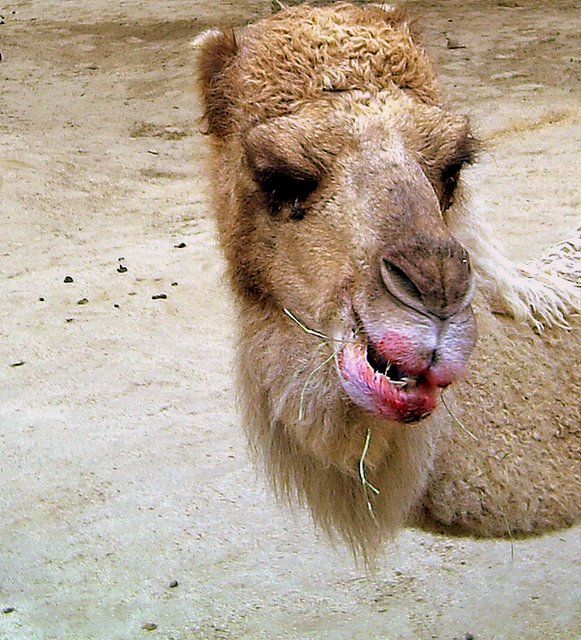

That's not pucker paint on our camel. Ms. or Mr. (?) camel just finished a bowl full of berries.
Thursday, September 14, 2006
???????????????????????????????????????????????????????
What do you do for fun?
???????????????????????????????????????????????????????
bike riding skiing photography reading cooking sewing
gardening driving shopping computing dancing football
tennis sex walking boating decorating writing painting gaming
raising animals astronomy rock climbing traveling music watching
TV singing acting building fishing bowling horseback riding
talking swimming hiking motorcycling studying surfing
designing playing chess golf softball jogging drawing
eating flying night clubs playing with pets collecting . . .
????????????????????????????????????????????????????????
Which ones? How often?
????????????????????????????????????????????????????????
A person who doesn't have a balanced life, for example, work, recreation, and other activities, may gradually come to experience what is often called ordinary or garden variety depression. Significantly reduced or increased appetite or sleep, listlessness, a lack of energy or interest in life, sadness, blunted or constricted emotions, a general slowing in responsiveness and activity, trouble doing routine household tasks, and so on are characteristics. High drive college students, professionals, and others who devote nearly all their energies to achievement and accomplishment may gradually come to experience ordinary or garden variety depression.
Persons with a history of gender dysphoria also often report depression, or sometimes, even more serious forms of a deeper depression. That state typically leads to a reduction in the quality of life and problems functioning. Regularly engaging in recreational or fun oriented activities, especially those that involve some vigorous movement for an extending period of time, say, 45 minutes or so per day, or at least several times per week, may contribute to a reduction in some forms of depression. When this approach is indicated, a person shouldn't expect results immediately; it may take a few weeks or more to show positive results.
In other words, doing fun activities may contribute to a sense of well being and can help a person construct a life that works, a life that provides a sense of quality, peace and happiness. I must add, however, some depression is the result of events other than restricted lives; such things as lack of work, relationship problems, physical illness, or perhaps the loss of a loved one. There also are biologically based forms of depression involving a chemical imbalance in one's brain that in most cases is probably inherited. These types of depression are often deeper, recurrent and may only yield to more aggressive forms of treatment such as psychotherapy, often combined with antidepressant medication, prescribed by a physician, typically a psychiatrist.
In general, depression is probably the most common form of emotional distress people experience. It's something we all experience from time to time. However, it's treatable. But it's important to remember, for some forms of depression, professional help is essential.
What do you do for fun?
Subscribe to:
Posts (Atom)


