Sunday, July 15, 2007
Fancy that

Playwright and performance artist Scott Turner Schofield has come out in at least five different ways. When he was in high school—and was still living as a woman named Katie—he came out as a lesbian. In college at Atlanta’s Emory University (where he and this writer were classmates), he came out as transgender. But while those are powerful stories, they may be less surprising than the events that inspired Schofield’s latest show: As a young woman in Charlotte, North Carolina, Schofield came out at three debutante balls as a Southern belle.
For those who don’t know Dixie, the debutante ball is an annual Old South tradition in which young women put on elegant gowns, get paraded around mansions by tuxedoed young men and symbolically announce that they are ready to join society. For the debs, this ritual is called “coming out,” and the joke is not lost on Schofield. His solo piece Debutante Balls—which he performs twice this week at the Cherry Lane Theater as part of the queercentric Fresh Fruit Festival—pokes fun at the similarities between his time in cotillion culture and his journey within the realm of gender politics.
Schofield has unwittingly broken rules in both worlds. Consider, for instance, the story of his debutante gown: As a middle-class kid who didn’t arrive in the South until his teens, he didn’t know that upper-crust debs usually attend balls in white dresses and kid gloves. So what was his coming out attire? A spaghetti-strapped number with a long black skirt and a leopard-print bodice. Blanche DuBois would have died. . . .


Philippines: Crossing borders
Nadya Labi, writing in the May 2007 issue of the American magazine, The Atlantic, describes how amid the extreme sexual repression in Saudi Arabia, there's actually a frenzy of homosexual activity. One reason is that access to women is so restricted, and so the men turn to each other. Many of the men do not think of themselves as homosexual, and rationalize that they are going after men who look like women.
Appropriately, Labi's article is titled "The Kingdom in the Closet" to highlight the many paradoxes surrounding homosexuality in Saudi Arabia. Men openly look for other men in shopping malls, and through the Internet, yet they are always in danger of being arrested by the "mutawwa'in," the religious police fielded by the Committee on the Promotion of Virtue and Prevention of Vice.
Don't ask, don't tell
Labi describes the atmosphere in Saudi as one of "don't ask, don't tell," the phrase originally used to describe the US policy about homosexuals in the military. Officially, homosexuals were barred from the US military, but everyone knew they were there, and as long as they kept quiet, they wouldn't be expelled. In Saudi, it's an entire nation that works on a "don't ask, don't tell" policy, keeping all its homosexuals in the closet.
Now comes the overseas Filipino worker (OFW). I once attended a "despedida" [farewell party] for a very flamboyant Filipino "bakla" [gay man] who was leaving to work in Saudi and remember how his aunt sternly reminded him "to behave," with the threat: "Sa Saudi, pinupugutan ang ulo ng mga bakla" ["In Saudi, they behead homosexuals"]. Several months later I asked how "Jun" (not his real name) was and his relatives showed me pictures of him in drag (dressed as a woman) in Saudi. He was apparently having the time of his life, with claims that Saudi men were queuing for him ("pila-pila sila").
I thought of Jun reading The Atlantic article, especially because it had a photograph of someone with long flowing hair, a crown and a bouquet of flowers. The caption read: "Francis, in drag, the winner of a private beauty pageant held by Filipinos in Jeddah." Such beauty pageants are common, but not without risks. There have been raids and arrests and if participants are caught having sex, they could be liable for very severe punishments. Saudi law actually prescribes death for sodomy or anal intercourse.
Perhaps the out and out Filipino bakla are lucky in that they know how to skirt the rules. The Philippines isn't exactly that liberal so life here gives sufficient practice for the bakla when in comes to a life of happy subterfuge.
Labi mentions Filipinos several times, including one hilarious story about how 23 of them were arrested while holding a drag beauty pageant. They were dragged (pardon the pun) to the police station together with the evidence of their crime: wigs and makeup and photographs. Herded into a cell, the drag queens began to argue among themselves about who looked "the hottest" in the photographs. . . .
Frogs exposed to herbicides. . .
. . .don't know if they're Arthur or Martha.

A green tree frog
AUSTRALIAN drinking water standards are under scrutiny after scientific research linked commonly used herbicides to gender-bending in male frogs.
The National Health and Medical Research Council has decided to reassess its drinking water guidelines after miniscule traces of the herbicides atrazine and simazine were found to turn the frogs into hermaphrodites - creatures with male and female sex organs.Australian guidelines allow up to 40 parts per billion (ppb) of atrazine in drinking water before it is considered a public health risk. But scientific studies have found male frogs grow ovaries when exposed to the chemical at the miniscule level of 0.1ppb in water.
"The current Australian Drinking Water Guidelines specify that atrazine should not be detected in drinking water, and that if it is detected remedial action should be taken to stop contamination," said research council spokesman Nigel Harding. . . .
Saturday, July 14, 2007
Terri O'Connell, trans racecar driver
Daniel Weil, Gaywheels.com
 If you grew up a good ol' boy from Mississippi, a NASCAR career may have been high among your dream achievements -- especially if you wanted to make your racing-hero dad proud.
 J.T. Hayes faced just such a situation: With 500 wins on the NASCAR circuit and a promising career ahead of him, he thought he had found the "right" track... Almost.
A series of events and one particularly awful racing accident in 1991 shifted J.T.'s perceptions. Trapped upside-down by his seatbelt, seeing fuel pouring and smoke billowing from the vehicle, J.T. Hayes decided life was really too short to not live it as who you are.
To greatly simplify the story, a decision was made -- and cars were sold -- to finance a gender-reassignment surgery that put a racing career on hold. In time, the sheltering and constraining cocoon of J.T. Hayes had disappeared, and Terri O'Connell emerged to take the wheel. . . .
COMMENTARY: All in this together
Two Outfest films see gender reassignment as a group transition.
By Christine Daniels
Times Staff Writer
July 13, 2007
WHEN ANNE MET LEA — a very different proposition from "When Harry Met Sally," on virtually every conceivable level — the occasion seemed ordinary enough. Anne was the mother of a teenage musical prodigy. Lea was a journalist researching a profile on the girl.
Or so that was the facade, not the first Lea had shown to Anne, as we quickly discover in the film "Another Woman." Anne senses something familiar about Lea, wondering if the two had previously met, perhaps at a museum.
Facing this line of questioning, Lea appears as if she is about to jump out of her skin. "Maybe I have a double," Lea says as she abruptly bolts from the table, nervously jams her fists into the pockets of her stylish trench coat, and leaves Anne sitting behind, just as she had done a decade before.
Ten years earlier, Lea was Anne's husband, Nicholas.
This 2002 French film, featuring Nathalie Mann as Lea/Nicholas and Micky Sebastian as Anne, is one of eight transgender-themed films showing at this year's Outfest. "Another Woman" debuts at 8 p.m. Sunday at the Directors Guild of America Theater 2 and, along with the new U.S. documentary "Red Without Blue" (debuting at 8 tonight, same theater), keenly captures the inherent contradiction of transsexual transition: a journey that is usually begun in isolation — both physical and spiritual — despite the inescapable reality that no one ever transitions alone.
As a transsexual woman, I realize I watch trans-themed movies through a different filter. Minor details that clank off-key can ruin an entire production for me. In both of these films, there is dialogue that rings so laser-beam true to what I have experienced and what my friends have experienced, it made me squirm with discomfort.
At the heart of both films is the very real struggle over language after a transsexual comes to terms with the truth and works up the courage to announce it. Those closest to the transsexual will often exclaim, "How can you do this to us?" The transsexual will often respond, "How can you not understand that I have no choice? I was born with this." . . .
I GAVE UP EVERYTHING TO BE A WOMAN. . .
. . .IT WAS THE BIGGEST MISTAKE OF MY LIFE
13/07/2007
PAULA Vendyback is a post-op transsexual who was born a boy called Paul. Here Paula, 40, from Leicester, tells how changing gender has meant sacrificing a lot more than the obvious...
'FOR as long as I can remember I knew I was different. Even in school, I didn't fit in. On paper I seemed like any other kid. I loved sport and was on the football team.
But inside I was a mess. I can't explain it, I just didn't feel like I should be a boy.
I remember from a young age seeing women in the street and wishing I could be one of them. When I was 13, I even started to sneak back home in lunch breaks and try on my sister's underwear. I loved the feel of the fabric, it was so much softer than men's clothes.
Don't get me wrong, I felt disgusted with myself for doing it. I was unable to explain these urges and I knew I couldn't tell anyone about them. But there was no way to stop myself.
I left school at 16 to become a painter and decorator. I loved the job but it just made me feel even more uncomfortable in my own skin. The building trade is very male-dominated and I didn't belong.
In the end the urge to speak to someone about it became overwhelming and I finally confessed to my boss that I liked to wear women's clothes. He was understanding and even said he knew people who liked to do the same thing but he said he didn't want other staff to know.
As it turned out, I didn't have a choice. Gossip spread, my clients found out and one by one they stopped booking me. Before I knew it, I no longer had a job and my life started to spiral downwards. I went from successful to suddenly being unemployed and living in a bedsit barely bigger than a cupboard.
In the end I turned to a psychologist for help and she diagnosed me as a transsexual. I can't explain the relief of finally having someone who understood what I was going through - but it was to be the start of further problems. I decided to undergo an operation to change my sex. I was so desperate to be a woman and thought this would finally solve my problems. . . .
Friday, July 13, 2007
Social trends favor transgender consumers
Consumer Rights: In 2000, 3.8% of the US population lived in legal jurisdictions that explicitly protected the consumer rights of transgendered consumers. Six years later that percentage has increased eightfold to 31% This percentage does not include the legislation recently passed in New Jersey (passing by a 10-to-1 majority) making it the ninth state to outlaw discrimination against their transgender residents.
Corporate Policies: In 1997, Lucent Technologies because the first Fortune 500 company to include 'gender identity and/expression' in their anti-discrimation/sexual harassment policies. Less than ten years later, there are now 110 Fortune 500 companies extending these protections to their transgendered employees and employment applicants.
Corporate Advertising: Corporate American has learned that there is no significant backlash to advertising to the GLBT market and substantial rewards for doing so. The number of corporations advertising in GLBT media has tripled over the last ten years. Advertising has awaken the GLBT consumer to their power in the marketplace.
Spending Power: The GLBT market spends an estimated $464,000,000,000. The transgendered population of the United States is generally recognized to be 10% of the GLBT population of 16,000,000 and as such they spend roughly $46,000,000,000 annually.
Social Acceptance: Social analysts were surprised by the results of a 2002 national poll. 74% of those polled said they would have no objection to working with a transgendered co-worker. 77% feel that transgendered children should be allowed to attend public shcools. 68% favor protections for transgendered individuals against hate crimes. These numbers suggest that society is ready for the transgendered individual to become a more active member of their community.
Hollywood and the Media: 'Transamerica' and the acclaim Felicity Huffman recieved for her portrayal of a transgendered individual is merely the best example (and by no means the only example) of a new sensitivity in the media towards transgendered individauls, a willingness to portray them as more deserving of compassion than ridicule. . . .
Transgender leader of The Cliks hopes to make a musical statement
NEW YORK (AP) — Lucas Silveira wears his heart on his tattoo sleeve.
The frontman of Toronto rock band The Cliks bares a turbulent tapestry on his arm: a dragon leaping through flames and waves, two guns bearing wide wings, and the word "Survivor."
"This is all to commemorate what I went through," says Silveira, who is transgender. He notes that transgender people are more likely to commit suicide than others — and he knows the pain involved: "I went to that place, and I know where that comes from. I felt so lucky that I got through it that this was to commemorate the entire ordeal."
Silveira is the first out transgender artist to be signed to a high profile label, Tommy Boy's gay-friendly imprint Silver Label. These days he is trying to build a career as he rebuilds his life as a biological female who identifies as male.
The Cliks were featured on the recent gay-oriented "True Colors Tour," playing alongside Cyndi Lauper, Erasure and Debbie Harry. This spring they released "Snakehouse," an emotional, guitar-driven album. Their single "Oh Yeah" spent several weeks atop a musical countdown on Logo, the gay-themed cable network.
Performers who defy the status quo face a unique challenge: living up to the hype on an artistic level that their unique identities generate. Sometimes, these acts rely on novelty alone for sales and popularity. Conversely, Silveira hopes his artistry will eventually outshine a gender identity that has become edgy in the pop mainstream.
At first glance the singer, who declines to give his age, looks like a petite tomboy with stylish, cropped locks and thick, lush eyelashes. While shopping for sneakers in downtown Manhattan ("I love shoes, man," he gushes), salesmen offer him women's sizes even though he asks for men's. Silveira knows he looks more female than male; on his records he sounds like it too. He sacrificed the male attributes hormones offer to maintain his singing voice. Instead, he underwent a double mastectomy to feel more comfortable in his skin.
"People are like, 'How opportunistic of you. Is this a gimmick? Do you think it's stylish to be this way?" he says of skeptics. "And I am like, 'Yeah, I am really, really into having a double mastectomy for fashion.'"
In recent months, the transgender community has gotten a surge of exposure on television ("All My Children," "Ugly Betty") and in film (2005's award winning "Transamerica" and documentaries like "Alexis Arquette: She's My Brother"). These works have banked on the characters' transgender experience to draw audiences. However, The Cliks' work is more vague. They deliver the standard rock fare of emotional songs that express trials that are not transgender so much as they are human.
"I think that authenticity is reflected in their particular single and I can only theorize that is why it has caught on," says Brian Graden, president of Logo and of entertainment at MTV Networks Music Group. "I don't think it's because of any hook of being transgender."
Graden adds that being transgender is "one of the last frontiers of non-understanding in our culture." But of late, more people "exploring that subject refused to be coded or denied." . . .
Self-castrating inmate sues for hormone therapy
An Idaho inmate who identifies as a transgender woman—and who performed a self-castration while in prison—is suing the state federal court to get female hormone therapy to treat her gender identity disorder, reports the Associated Press.
Jenniffer Spencer, born Randall Gammett, claims the Idaho Department of Correction is violating her constitutional right to proper health care and subjecting her to cruel and unusual punishment by failing to diagnose her gender identity disorder and give her access to the female hormone estrogen. She performed her own castration using a disposable razor blade in her prison cell.
According to the Associated Press, the state's attorneys argue that prison doctors did not find substantial evidence that Spencer had gender identity disorder. After her castration Spencer was given an option to undergo male hormone therapy, which she refused. . . .
Thursday, July 12, 2007
Bobby Darling out of Big Boss
This video is mostly in Hindi. Nevertheless, if you don't understand what's being said there's still plenty of nonverbal action to observe as Bobby is evicted from the reality show "Big Boss."
Contracepting the Environment
Environmentalists Mum on Poisoned Streams
BY WAYNE LAUGESEN
REGISTER CORRESPONDENT
July 15-21, 2007 Issue | Posted 7/10/07 at 2:25 PM

BOULDER, Colo. — When EPA-funded scientists at the University of Colorado studied fish in a pristine mountain stream known as Boulder Creek two years ago, they were shocked. Randomly netting 123 trout and other fish downstream from the city’s sewer plant, they found that 101 were female, 12 were male, and 10 were strange “intersex” fish with male and female features.
It’s “the first thing that I’ve seen as a scientist that really scared me,” said then 59-year-old University of Colorado biologist John Woodling, speaking to the Denver Post in 2005.
They studied the fish and decided the main culprits were estrogens and other steroid hormones from birth control pills and patches, excreted in urine into the city’s sewage system and then into the creek.
Woodling, University of Colorado physiology professor David Norris, and their EPA-study team were among the first scientists in the country to learn that a slurry of hormones, antibiotics, caffeine and steroids is coursing down the nation’s waterways, threatening fish and contaminating drinking water.
Since their findings, stories have been emerging everywhere. Scientists in western Washington found that synthetic estrogen — a common ingredient in oral contraceptives — drastically reduces the fertility of male rainbow trout.
Doug Myers, wetlands and habitat specialist for Washington State’s Puget Sound Action Team, told the Seattle Post-Intelligencer that in frogs, river otters and fish, scientists are “finding the presence of female hormones making the male species less male.” . . .
UK News: Why Ambiguous Avatars Are A Turn Off
It turns out we find androgynous computer generated images less trustworthy than those who are clearly male or female.
People regularly use avatars online while chatting with friends or exploring virtual worlds and companies are increasingly using them to interact with customers.
To find out whether your choice of avatar affects how others perceive you researchers Kristine Nowak and Christian Rauh of the University of Connecticut paired up volunteers and asked them to chat by typing messages into a computer.
Although they didn't meet face to face each person was shown a computer-generated image representing the other person.
These avatars ranged from an obviously female blonde to ones with no clear gender to strong-jawed males, reports New Scientist.
When asked to rate the other person the volunteers found those represented by androgynous-looking avatars less
"credible".
Similarly a second group of volunteers was asked to make snap judgements based on a glimpse of the images - and they were also less willing to trust the androgynous ones.
The researchers say androgyny makes avatars appear less human causing a breakdown in trust and people should consider this when selecting one. Distrust could also stem from a lack of context.
"If someone says 'that's so sweet' was it sisterly or patronising," asks Judith Donath of Massachusetts Institute of Technology's Media Lab."
If it's difficult to tell knowing someone's gender can help you sort it out, she says.
Sonia Faleiro. . .more on Bobby Darling
Friday, 25 November 2005
Liberty! Equality! Fraternity!
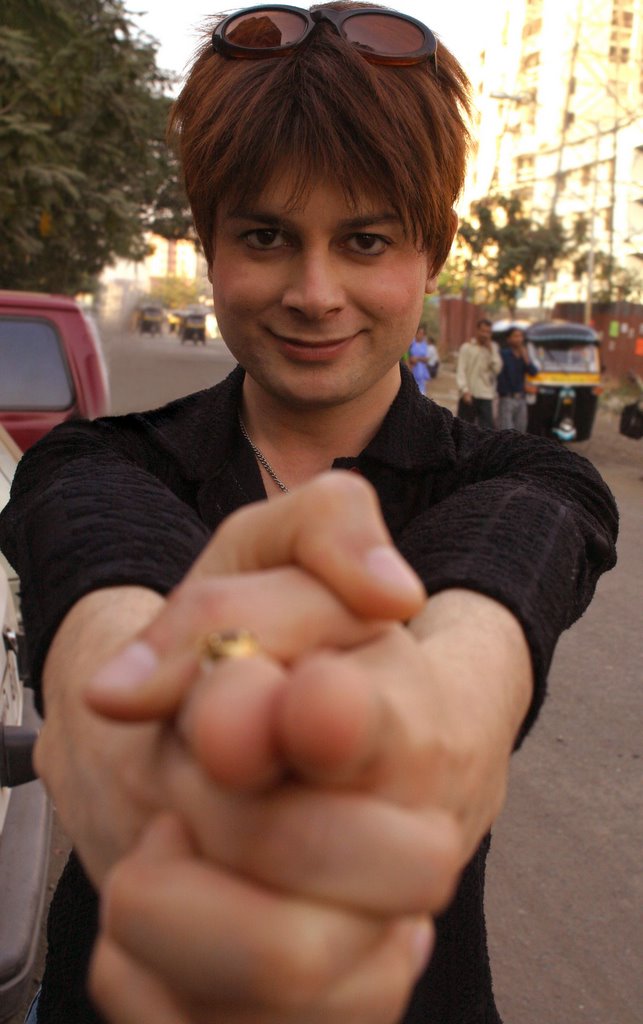
As a boy, Pankaj Sharma realised he preferred being a woman. He paid for his ‘deviance’ when his father disowned him. Giving up was not in his script. So he ran away to Mumbai to reinvent himself. Today, he is Bobby Darling, the actor who redefines gender anew in a conservative industry, writes Sonia Faleiro.
Bobby Darling totters down the road in transparent block heels embroidered with pink flowers, denim hipsters, and a black lace shirt. One long white finger is crowned with a diamond, on another, a moonstone catches the light. His glossy brown hair switch, 12 o’ clock shadow, and a hint of cleavage induced by hormone pills he started taking five months ago, encourage a group of little boys to feign a drunken stagger: “Bobby Darling, oh Bobby Darling!” Another crowd of children, can’t get enough of the actor. “Bobby Darling!” they sigh, cuddling him. Bobby Darling appears impervious to the first reaction, and at the second, smiles, tosses his hair, wiggles a manicured finger: “Go wash your hands, first.” . . .
India: Interview with television & film actor Bobby Darling
| |||
| Posted on 28 February 2004 | |||
| How could we have bypassed an extremely unusual face on the small and big screen both? Our sleuths inform us that he is a gay who does not go by his actual name Pankaj Sharma but calls himself Bobby Darling. Big deal! What surprises, sorry, shocks us is the additional information that he is screaming from the rooftops about his deviant sexual behaviour. We track him down on his mobile and he invites us home. I express that it would be better if we catch up at a food or a coffee joint. He laughs, "Are you scared?" We have been challenged. An hour later, we are ringing his doorbell. It's pitch dark inside. No one attends. We are about to return. Just before we turn back, he comes roaring from behind, in a sleeveless T-shirt. "Hi," he nearly shrieks. As we enter his flat, we start straight-away. We are feeling slightly uncomfortable and would prefer to finish this fast. Here's an excerpt of what transpired between indiantelevision.com's Vickey Lalwani and Bobby Darling: | |||
| Being a gay, how did you get into films? | |||
| | |||
| But what makes you go so open? | |||
| | |||
| Rolling backwards. When and how did you realize that you were a gay? | |||
| | |||
| What happened when his parents came to know? | |||
| | |||
| And then? | |||

D.C. marks the first-ever Transgender Awareness Month

Published on July 12, 2007
If you haven't been to Unity Fellowship Church in Northwest in the past two weeks, you might not know that it's Transgender Awareness Month. But for those in the know, including local transgender activist Toni Collins, , it's a positive effort to bring the GLBT community closer together by building awareness about its transgender members.
''It's really still a very marginalized community and we're just trying to strengthen our bond between the [GLBT] community by making the community aware that we have a voice,'' says Collins, a board member of Transgender Health Empowerment (THE).
The awareness month events at Unity Fellowship, organized by THE and a planning committee, mark the first Transgender Awareness Month in Washington, Collins says. . . .
Wednesday, July 11, 2007
Follow-Up: More Info for Gender Variant Children and Their Parents
Re: this week's cover feature by Lauren Smiley ("Girl/Boy Interrupted -- A New Treatment For Transgender Kids Puts Puberty On Hold So That They Won't Develop Into Their Biological Sex"), parents with gender variant children can access a growing number of resources:
A support group for Bay Area parents of gender variant and transgender children, co-sponsored by Children’s Hospital Oakland.
The first Gender Odyssey Family Conference is scheduled for Labor Day weekend in Seattle, Washington. The conference will provide family programming for gender variant or transgender children and adolescents.
TransYouth Family Advocates is an organization dedicated to raising awareness of the cultural and medical issues facing transgender youth and families.
The PFLAG Transgender Network provides resources for families and produces an online newsletter called eTransParent.
The World Professional Association for Transgender Health (WPATH) approved the GnRH blocking treatment for adolescents in its most recent treatment guidelines.
The Gender Identity and Research Society (GIRES) is a UK-based non-profit. Its website includes information on GnRH blocking treatment. Click on “Endocrine Treatment for Adolescents” in the left-hand panel.
The Dimensions Clinic in San Francisco provides medical care for transgender teens.
The Transgender Law Center is a San Francisco-based civil rights organization.
For a list of additional transgender resources, check out the list compiled by ABC News.


