. . .from A.E.Brain
In German, yet, from ArzteZeitung (Doctor's Journal)
Ok, here's a partial free translation:
"An Examination of the use of fMRT for diagnosing Transsexuality
The brains of anatomically male transsexuals, who identify as female, did not react as typical males do to visual erotic stimuli. In a study using functional MagnetoResonanceTomography(MRT) the reaction was instead typically female.
This work was performed by the University of Essen. 36 subjects were shown visually erotic films, while fMRT was used to study the reactions inside the brain. The study was performed co-operatively with the Klinik für Psychosomatik, and attempted to answer the question of whether fMRT could be used to diagnose Transsexuality, and especially to help in the decision to permit Sex Reassignment Surgery.
Twelve heterosexual men and twelve heterosexual women were examined, along with twelve anatomical males who identify as women. As Dr. Elke Gizewski stressed at the Röntgenkongreß in Berlin, it was already well-known from preliminary investigations of other groups that differences between men and women appear in fMRT when they are presented with erotic stimuli.
In men, the limbic system and upper regions of the hypothalamus, the amygdalae and the insular cortex were activated substantially more strongly. “We confirmed this finding in the comparison between the heterosexual men and women of our Cohort”, said Gizewski.
This specifically male activation of the limbic system was not found in the transsexual sample. Under fMRT, the pictures corresponded rather accurately to those of the female sample.
Radiologists can now confirm what transsexuals report - that they feel “trapped in the wrong body” - on the basis of the activation of the brain when presented with erotic stimuli. There is obviously a biological correlation with the subjective feelings."
I'm not sure that's wholly proven. I'd need comparison tests between Gay men, Lesbian women, and Gay, Straight and Lesbian Transsexuals (both FtoM and MtoF) too. It may be that the sample of transsexual women were all Hetero, none Lesbian. If so, it may only prove a biological basis for sexual preference, rather than gender as such.
But that in itself would be even more unacceptable to those who persecute us, and call us "mentally ill".
Thursday, September 27, 2007
Sex change funding undermines no gays claim
· Ahmadinejad account rejected in Iran
· Homosexuality illegal but transsexuals tolerated
Robert Tait in Tehran
Wednesday September 26, 2007
Guardian
When Mahmoud Ahmadinejad, Iran's combative president, provoked his latest controversy in New York this week by asserting that there were no homosexuals in his country, he may have been indulging in sophistry or just plain wishful thinking.
While Mr Ahmadinejad may want to believe that his Islamic society is exclusively non-gay, it is a belief undermined by the paradox that transsexuality and sex changes are tolerated and encouraged under Iran's theocratic system.
Iran has between 15,000 and 20,000 transsexuals, according to official statistics, although unofficial estimates put the figure at up to 150,000. Iran carries out more gender change operations than any country in the world besides Thailand.
Sex changes have been legal since the late Ayatollah Ruhollah Khomeini, spiritual leader of the 1979 Islamic revolution, passed a fatwa authorising them nearly 25 years ago. Whereas homosexuality is considered a sin, transsexuality is categorised as an illness subject to cure.
While the government seeks to keep its approval quiet, state support has increased since Mr Ahmadinejad took office in 2005. His government has begun providing grants of £2,250 for operations and further funding for hormone therapy. It is also proposing loans of up to £2,750 to allow those undergoing surgery to start their own businesses.
Maryam Khatoon Molkara, leader of the country's main transsexual organisation, said some of those undergoing operations were gay rather than out-and-out transsexuals. "In Iran, transsexuals are part of the homosexual family. Is it possible that a phenomenon exists in the world but not in Iran? Transsexuality is a real disaster. It's a one-way street. But if somebody wants to study, have a future and live like others they should go through this surgery."
At Columbia University on Monday, Mr Ahmadinejad said homosexuality did not exist in Iran. "In Iran we don't have homosexuals like in your country," he told a questioner who accused his government of executing gay people. "In Iran we do not have this phenomenon. I don't know who has told you that we have it."
But Ms Molkara - who persuaded Khomeini to issue the fatwa on transsexuality - said his stance was inconsistent with the state's sex-change policy. "They are saying homosexuality doesn't exist, but they have never given me a chance to use my influence among transsexuals to prevent transsexuality from happening," she said. "You could change the culture but the press and state TV are not allowed to write or say anything about transsexuality.". . .
· Homosexuality illegal but transsexuals tolerated
Robert Tait in Tehran
Wednesday September 26, 2007
Guardian
When Mahmoud Ahmadinejad, Iran's combative president, provoked his latest controversy in New York this week by asserting that there were no homosexuals in his country, he may have been indulging in sophistry or just plain wishful thinking.
While Mr Ahmadinejad may want to believe that his Islamic society is exclusively non-gay, it is a belief undermined by the paradox that transsexuality and sex changes are tolerated and encouraged under Iran's theocratic system.
Iran has between 15,000 and 20,000 transsexuals, according to official statistics, although unofficial estimates put the figure at up to 150,000. Iran carries out more gender change operations than any country in the world besides Thailand.
Sex changes have been legal since the late Ayatollah Ruhollah Khomeini, spiritual leader of the 1979 Islamic revolution, passed a fatwa authorising them nearly 25 years ago. Whereas homosexuality is considered a sin, transsexuality is categorised as an illness subject to cure.
While the government seeks to keep its approval quiet, state support has increased since Mr Ahmadinejad took office in 2005. His government has begun providing grants of £2,250 for operations and further funding for hormone therapy. It is also proposing loans of up to £2,750 to allow those undergoing surgery to start their own businesses.
Maryam Khatoon Molkara, leader of the country's main transsexual organisation, said some of those undergoing operations were gay rather than out-and-out transsexuals. "In Iran, transsexuals are part of the homosexual family. Is it possible that a phenomenon exists in the world but not in Iran? Transsexuality is a real disaster. It's a one-way street. But if somebody wants to study, have a future and live like others they should go through this surgery."
At Columbia University on Monday, Mr Ahmadinejad said homosexuality did not exist in Iran. "In Iran we don't have homosexuals like in your country," he told a questioner who accused his government of executing gay people. "In Iran we do not have this phenomenon. I don't know who has told you that we have it."
But Ms Molkara - who persuaded Khomeini to issue the fatwa on transsexuality - said his stance was inconsistent with the state's sex-change policy. "They are saying homosexuality doesn't exist, but they have never given me a chance to use my influence among transsexuals to prevent transsexuality from happening," she said. "You could change the culture but the press and state TV are not allowed to write or say anything about transsexuality.". . .


'Oh, the things I did!'
Lou Reed sang about her and Andy Warhol made her a superstar. As Holly Woodlawn heads for Britain, John Patterson meets a drag queen legend
John Patterson
Wednesday September 26, 2007
Guardian
"Holly came from Miami F-L-A,
Hitchhiked her way across the USA,
Plucked her eyebrows on the way,
Shaved her legs and then he was a she ..."
That's how Lou Reed made Holly Woodlawn, the Warhol Factory superstar and legendary drag queen, famous in his 1972 song Walk on the Wild Side. Here's Woodlawn's expanded version: "I was 15 years old and failing at high school in Miami Beach because I was too busy partying. I was supposed to go to summer school to catch up and really didn't want to, so I joined some of these Cuban queens to go to New York. I hocked some jewellery and we made it all the way to Georgia, where the money ran out and we had to hitchhike the rest of the way.
"Atlanta, Georgia, of all places - you could expect to be tarred and feathered and murdered in those days! But we survived and I remember the first time I saw New York: the Emerald City. I thought the sidewalks were made of diamonds because of the specks of mica in the asphalt. It was 1962. Marilyn had just died. I lived on the streets like everyone does when they run away. I met some girlfriends who took me in and we found a place in Queens. I was really lucky. I met this guy who fell in love with me and asked me to be his girlfriend. I started taking hormones for a sex-change and lived as his wife, working in the days as a clothing model at Saks Fifth Avenue. Oh, the things I did! And for six or seven years they never knew I was a boy. Not a clue!"
I meet Woodlawn at her apartment in West Hollywood, Los Angeles' gay village or ghetto, on a sweltering hot day. In a few weeks she'll be in the UK to promote an exhibition of paintings of herself by the British artist Sadie Lee, showing her in a less glamorous guise than usual. "I said, 'Why don't you paint me as everyday me for a change, instead of all peaches and cream?'" she says.
As we sit on her balcony talking, we're favoured with an ambient soundtrack that, appropriately, seems more redolent of Manhattan than of sleepy California: a fire nearby means that we're constantly interrupted by screaming sirens. "All right, already," howls Woodlawn. "Find the fucking fire and shut up. I swear, West Hollywood is breeding pyromaniacs today."
The Holly Woodlawn of 2007 is a far cry from the sweet-voiced cross-dresser who made her first splash in the film Trash in 1970, fake-masturbating with a Miller beer bottle to considerable acclaim. Back then - during what we must inevitably call her 15 minutes of fame - she was one of the many drag queens and hustlers at the lower end of the Warhol social scene, congregating around his Factory studio and at hangouts like the bar Max's Kansas City. "The mole people," Factory manager Billy Name called them. "The amphetamine people." At the other end were the rich, famous and powerful: Jim Morrison, Yoko Ono, Janis Joplin, author George Plimpton.
The 61-year-old man who answers the door today is out of drag, bent and frail, though indefatigably cheerful, using a Zimmer frame because of various slowly fusing discs in his spine that, he says, are unimaginably painful and incurable. "Oh no, this is IT, honey, downhill all the way from here on!". . .
John Patterson
Wednesday September 26, 2007
Guardian
"Holly came from Miami F-L-A,
Hitchhiked her way across the USA,
Plucked her eyebrows on the way,
Shaved her legs and then he was a she ..."
That's how Lou Reed made Holly Woodlawn, the Warhol Factory superstar and legendary drag queen, famous in his 1972 song Walk on the Wild Side. Here's Woodlawn's expanded version: "I was 15 years old and failing at high school in Miami Beach because I was too busy partying. I was supposed to go to summer school to catch up and really didn't want to, so I joined some of these Cuban queens to go to New York. I hocked some jewellery and we made it all the way to Georgia, where the money ran out and we had to hitchhike the rest of the way.
"Atlanta, Georgia, of all places - you could expect to be tarred and feathered and murdered in those days! But we survived and I remember the first time I saw New York: the Emerald City. I thought the sidewalks were made of diamonds because of the specks of mica in the asphalt. It was 1962. Marilyn had just died. I lived on the streets like everyone does when they run away. I met some girlfriends who took me in and we found a place in Queens. I was really lucky. I met this guy who fell in love with me and asked me to be his girlfriend. I started taking hormones for a sex-change and lived as his wife, working in the days as a clothing model at Saks Fifth Avenue. Oh, the things I did! And for six or seven years they never knew I was a boy. Not a clue!"
I meet Woodlawn at her apartment in West Hollywood, Los Angeles' gay village or ghetto, on a sweltering hot day. In a few weeks she'll be in the UK to promote an exhibition of paintings of herself by the British artist Sadie Lee, showing her in a less glamorous guise than usual. "I said, 'Why don't you paint me as everyday me for a change, instead of all peaches and cream?'" she says.
As we sit on her balcony talking, we're favoured with an ambient soundtrack that, appropriately, seems more redolent of Manhattan than of sleepy California: a fire nearby means that we're constantly interrupted by screaming sirens. "All right, already," howls Woodlawn. "Find the fucking fire and shut up. I swear, West Hollywood is breeding pyromaniacs today."
The Holly Woodlawn of 2007 is a far cry from the sweet-voiced cross-dresser who made her first splash in the film Trash in 1970, fake-masturbating with a Miller beer bottle to considerable acclaim. Back then - during what we must inevitably call her 15 minutes of fame - she was one of the many drag queens and hustlers at the lower end of the Warhol social scene, congregating around his Factory studio and at hangouts like the bar Max's Kansas City. "The mole people," Factory manager Billy Name called them. "The amphetamine people." At the other end were the rich, famous and powerful: Jim Morrison, Yoko Ono, Janis Joplin, author George Plimpton.
The 61-year-old man who answers the door today is out of drag, bent and frail, though indefatigably cheerful, using a Zimmer frame because of various slowly fusing discs in his spine that, he says, are unimaginably painful and incurable. "Oh no, this is IT, honey, downhill all the way from here on!". . .
Book excels in gender issues
Encourages student in identifying, coping during changes
By: Ruth Lane
Posted: 9/27/07
A rare event has occurred in the area of gender studies - the publication of "The Whipping Girl: A Transsexual Woman On Sexism and The Scapegoating of Femininity" by Julia Serano. Not often do readers have the luxury of reading a thorough, fairly objective yet personal appraisal of misogyny from a transsexual woman. In this segment, I will simultaneously present a review of "The Whipping Girl" while tying what Serano writes into some of my personal experiences with gender.
Serano's book courageously presents situations in which femininity is treated with sincere disdain. The book's main focus is to show how transgender phobia is not based on dislike of persons who are transgender solely for those persons being transgender. Rather, transphobia is described as being based on the hatred of femininity. What is most striking in the book is how Serano sheds light on the ways in which femininity in particular is frowned upon within the queer community and explores how masculinity is often most applauded. When femininity is accepted in the queer community, it is within the drag show setting where femininity becomes a show, an act to please an audience. Serano repeatedly illustrates how society as a whole carries the perception that femininity is a farce created to please those who witness it.
To make this more personal, in my late teens I transitioned from female to male, and I identified somewhere between being a gay male and a bisexual male. To fully embody living as a male, I underwent a series of physical alterations such as two years of testosterone hormone therapy and several surgeries that ultimately gave me a masculine appearance. But after the two years of transition, I began to have an experience similar to what Serano describes in her book. The experience was that my subconscious sex was misaligned with my physical body. In my early 20s, I decided to de-transition and live as a woman again because I came to realization that my subconscious sex is female. . . .
By: Ruth Lane
Posted: 9/27/07
A rare event has occurred in the area of gender studies - the publication of "The Whipping Girl: A Transsexual Woman On Sexism and The Scapegoating of Femininity" by Julia Serano. Not often do readers have the luxury of reading a thorough, fairly objective yet personal appraisal of misogyny from a transsexual woman. In this segment, I will simultaneously present a review of "The Whipping Girl" while tying what Serano writes into some of my personal experiences with gender.
Serano's book courageously presents situations in which femininity is treated with sincere disdain. The book's main focus is to show how transgender phobia is not based on dislike of persons who are transgender solely for those persons being transgender. Rather, transphobia is described as being based on the hatred of femininity. What is most striking in the book is how Serano sheds light on the ways in which femininity in particular is frowned upon within the queer community and explores how masculinity is often most applauded. When femininity is accepted in the queer community, it is within the drag show setting where femininity becomes a show, an act to please an audience. Serano repeatedly illustrates how society as a whole carries the perception that femininity is a farce created to please those who witness it.
To make this more personal, in my late teens I transitioned from female to male, and I identified somewhere between being a gay male and a bisexual male. To fully embody living as a male, I underwent a series of physical alterations such as two years of testosterone hormone therapy and several surgeries that ultimately gave me a masculine appearance. But after the two years of transition, I began to have an experience similar to what Serano describes in her book. The experience was that my subconscious sex was misaligned with my physical body. In my early 20s, I decided to de-transition and live as a woman again because I came to realization that my subconscious sex is female. . . .
Wednesday, September 26, 2007
Leonard to Leona, Singapore transsexual bares all
Tue Sep 25, 2007 8:20am EDT
By Miral Fahmy
SINGAPORE (Reuters Life!) - At the age of 10, Leonard Lo was determined to become a woman.
Now 22 years later, Singaporean transsexual Leona Lo details the shame and anger she felt on her journey in a cathartic book that is raising eyebrows in this regulated city-state with old-fashioned attitudes toward sex.
Lo, 32, runs her own public relations company. She has an Australian boyfriend, polished nails and an engaging, slightly nervous, laugh. She has been admitted to a psychiatric hospital and attempted suicide. Her middle-class, conformist Singaporean-Chinese parents took several years to accept her.
Lo is not Singapore's only transsexual, but one of its most outspoken. She has her own Web site (www.leonalo.com), speaks extensively to the media, lectured at universities and corporate functions, driven, she says, by desire to spare other transsexuals from a "difficult" society.
"From Leonard to Leona: A Singapore Transsexual's Journey to Womanhood" is Lo's first book but she is working on another -- a woman's guide to relationships.
Q: You're very frank in your autobiography. Was this hard?
A: "I like to think of my book as inspirational, to show that no matter what life throws your way, you can choose to be happy. I've reached the end of the road, I've attempted suicide, but now I am excited about life. A lot of sweat and tears went into this book, but I feel I have to share my story because I don't want another male child to go through the pain."
Q: Was it difficult to grow up as a transsexual in a conservative place like Singapore?
A: "I am conservative! I do not sleep around, I do not lead a deviant life. The problem with Singapore is the culture of silence which is the most terrible thing in the world, of sweeping things under the carpet. There is discrimination against transsexuals, there is stigma, there is shame. What did we ever do to deserve this? It took a lot of anger for me to overcome my shame and to realize that in Singapore, we need someone to help other transsexuals come out, which is what I am trying to do."
Q: Are you trying to be a role model?
A: "There is a lot of negative portrayal in most of Asia of transsexuals: they are all prostitutes or entertainers, people on the fringe. This is not the case in Europe or the United States, where transsexuals are respected professionals. I would like to be a voice for transsexuals in Asia. In some places like China and Japan, transsexuals are playing a public role, but in Southeast Asia, they're "ladyboys" who entertain. Why can't I become a member of parliament or contribute to my country?"
Q: You've been both a man and a woman. What's the best part of being female?
A: "Vanity! A woman is such a colorful person, able to express herself in so many ways, to dress up, to dance like crazy, to let herself be. You get away with a lot being a woman."
By Miral Fahmy
SINGAPORE (Reuters Life!) - At the age of 10, Leonard Lo was determined to become a woman.
Now 22 years later, Singaporean transsexual Leona Lo details the shame and anger she felt on her journey in a cathartic book that is raising eyebrows in this regulated city-state with old-fashioned attitudes toward sex.
Lo, 32, runs her own public relations company. She has an Australian boyfriend, polished nails and an engaging, slightly nervous, laugh. She has been admitted to a psychiatric hospital and attempted suicide. Her middle-class, conformist Singaporean-Chinese parents took several years to accept her.
Lo is not Singapore's only transsexual, but one of its most outspoken. She has her own Web site (www.leonalo.com), speaks extensively to the media, lectured at universities and corporate functions, driven, she says, by desire to spare other transsexuals from a "difficult" society.
"From Leonard to Leona: A Singapore Transsexual's Journey to Womanhood" is Lo's first book but she is working on another -- a woman's guide to relationships.
Q: You're very frank in your autobiography. Was this hard?
A: "I like to think of my book as inspirational, to show that no matter what life throws your way, you can choose to be happy. I've reached the end of the road, I've attempted suicide, but now I am excited about life. A lot of sweat and tears went into this book, but I feel I have to share my story because I don't want another male child to go through the pain."
Q: Was it difficult to grow up as a transsexual in a conservative place like Singapore?
A: "I am conservative! I do not sleep around, I do not lead a deviant life. The problem with Singapore is the culture of silence which is the most terrible thing in the world, of sweeping things under the carpet. There is discrimination against transsexuals, there is stigma, there is shame. What did we ever do to deserve this? It took a lot of anger for me to overcome my shame and to realize that in Singapore, we need someone to help other transsexuals come out, which is what I am trying to do."
Q: Are you trying to be a role model?
A: "There is a lot of negative portrayal in most of Asia of transsexuals: they are all prostitutes or entertainers, people on the fringe. This is not the case in Europe or the United States, where transsexuals are respected professionals. I would like to be a voice for transsexuals in Asia. In some places like China and Japan, transsexuals are playing a public role, but in Southeast Asia, they're "ladyboys" who entertain. Why can't I become a member of parliament or contribute to my country?"
Q: You've been both a man and a woman. What's the best part of being female?
A: "Vanity! A woman is such a colorful person, able to express herself in so many ways, to dress up, to dance like crazy, to let herself be. You get away with a lot being a woman."
Tuesday, September 25, 2007
Teenage and Transgendered
Liz and Amber were just friends until Liz became Jay
By Megan Feldman
Published: September 20, 2007
Jacoby James' palms were sweating. It was almost his turn. As a camera flash illuminated the curtains in front of him, he waited to have his senior picture taken at the Academy of Irving. The photographer's assistant beckoned. Wishing he weren't so nervous, James stepped forward.
The woman directed him to a clothes rack with two kinds of outfits made to slip over the head—for the girls, v-necked bodices modeled after dresses, and for the boys, half-shirts made to look like suits. James reached for one of the suit and tie sets.
"What's your name?" the woman asked.
He hesitated. "Missouri Flowers," he said, looking at the ground. He purposely left out Elizabeth, his middle name.
The woman stared at him for a moment, confused, then glanced down at her list.
"I'd like to wear the suit and tie," James told her.
"Um...I'm not sure we can do that," she finally said.
James steeled himself. He was no longer a frightened eighth-grader whose screaming classmates told teachers there was a boy in the girls' bathroom. As far as he was concerned, Elizabeth Flowers was gone. Gone with her longish brown hair and those blouses he'd always hated; gone with her quiet, almost painful inhibitions and the stomach-wrenching anxiety that came as people looked back and forth, confused, between the feminine name and more masculine features. His friends, family and teachers had been calling him Jay James for almost a year now—he had a straight girlfriend, for God's sake. There was no way in hell he would appear in his senior picture wearing that ridiculous, frilly piece of fabric. . . .
By Megan Feldman
Published: September 20, 2007
Jacoby James' palms were sweating. It was almost his turn. As a camera flash illuminated the curtains in front of him, he waited to have his senior picture taken at the Academy of Irving. The photographer's assistant beckoned. Wishing he weren't so nervous, James stepped forward.
The woman directed him to a clothes rack with two kinds of outfits made to slip over the head—for the girls, v-necked bodices modeled after dresses, and for the boys, half-shirts made to look like suits. James reached for one of the suit and tie sets.
"What's your name?" the woman asked.
He hesitated. "Missouri Flowers," he said, looking at the ground. He purposely left out Elizabeth, his middle name.
The woman stared at him for a moment, confused, then glanced down at her list.
"I'd like to wear the suit and tie," James told her.
"Um...I'm not sure we can do that," she finally said.
James steeled himself. He was no longer a frightened eighth-grader whose screaming classmates told teachers there was a boy in the girls' bathroom. As far as he was concerned, Elizabeth Flowers was gone. Gone with her longish brown hair and those blouses he'd always hated; gone with her quiet, almost painful inhibitions and the stomach-wrenching anxiety that came as people looked back and forth, confused, between the feminine name and more masculine features. His friends, family and teachers had been calling him Jay James for almost a year now—he had a straight girlfriend, for God's sake. There was no way in hell he would appear in his senior picture wearing that ridiculous, frilly piece of fabric. . . .
Argentine boy sex change approved
By Daniel Schweimler
BBC News, Buenos Aires
A court in the central Argentine province of Cordoba has for the first time agreed that a sex change operation can be carried out on a minor.
The case concerns a 17-year-old male called Nati who wants to be a woman.
The decision ends a long-running legal process for Nati, who suffers from the transsexual disorder known as Harry Benjamin Syndrome.
The judge insisted that Nati receive counselling after the operation, which will take place in the next few days.
Nati knew from an early age that she had been born with the wrong body.
The decision by the court in Cordoba, the first of its kind in Argentina, means that that can now be put right.
Legal fight
After the operation Nati will also be able to officially change her name and apply for new documentation.
I'm very happy, she said, that my real identity has been recognised.
This has become an emblematic case for people who have a gender identity different to their biological one
Cesar Cigliutti
Her parents and friends have supported the 17-year-old during a long and often tortuous legal process that saw some decisions go against her.
The president of the Argentine homosexual community, Cesar Cigliutti, was one of those supporters.
"Not only the operation has been authorised but also the necessary changes to her birth certificate," he said.
"What's important and unusual about this case is that Natalie is a minor - she is not yet 18 years old - and this has become an emblematic case for people who have a gender identity different to their biological one."
BBC News, Buenos Aires
A court in the central Argentine province of Cordoba has for the first time agreed that a sex change operation can be carried out on a minor.
The case concerns a 17-year-old male called Nati who wants to be a woman.
The decision ends a long-running legal process for Nati, who suffers from the transsexual disorder known as Harry Benjamin Syndrome.
The judge insisted that Nati receive counselling after the operation, which will take place in the next few days.
Nati knew from an early age that she had been born with the wrong body.
The decision by the court in Cordoba, the first of its kind in Argentina, means that that can now be put right.
Legal fight
After the operation Nati will also be able to officially change her name and apply for new documentation.
I'm very happy, she said, that my real identity has been recognised.
This has become an emblematic case for people who have a gender identity different to their biological one
Cesar Cigliutti
Her parents and friends have supported the 17-year-old during a long and often tortuous legal process that saw some decisions go against her.
The president of the Argentine homosexual community, Cesar Cigliutti, was one of those supporters.
"Not only the operation has been authorised but also the necessary changes to her birth certificate," he said.
"What's important and unusual about this case is that Natalie is a minor - she is not yet 18 years old - and this has become an emblematic case for people who have a gender identity different to their biological one."
Androgynous boy with female genitals refuses to become woman
25.09.2007 Source: Pravda.Ru
A Moscow-based hospital performed an operation on an androgynous boy who had a genetic set of chromosomes typical of female organisms. At his very young age the boy was diagnosed as having cryptorchidism. His parents, natives of the Middle East, wanted the son to grow older to have a special operation to solve the problem. The boy faced first problems in connection with the diagnosis at the age of twelve when he discovered that his genitals were bleeding. He told the mother about the problem. After special medical examinations doctors were shocked to discover that the male patient had an uterus and adnexa. The discovery in its turn clarified why the boy had his genitals bleeding. The boy had regular menstruation, head of the Urinology and Andrology Department at the Moscow Pediatrics and Infant Surgery Research Institute, Asaad Matar, told the Moskovsky Komsomolets newspaper.
The patient had a genetic test as a result of which it turned out that there were female chromosomes in his organism. Besides, the teenager felt that his breast was growing. Taking the transformations into their consideration, doctors suggested that the parents should have their son converted into a girl with the help of sex-change surgery. The medics explained that such a transformation would include the plastic surgery of the teenager’s vagina and the removal of the organ resembling a male penis. As a result of such changes the patient may have a chance to have children, like any healthy woman, specialists said.
But the young man insisted that he wanted to remain a boy. His parents said they were used to having an elder son, but not daughter.
Afterwards, the boy underwent a different surgery to have his female genitals removed. The boy endured the operation well. Two silicone testicles are going to be implanted into his scrotum soon.
Even though the operation was a success, doctors warn that the patient will never become a natural father. What is more, he will have to take a course of hormone therapy to maintain his male phenotype till the end of his life.
Experts say that hermaphroditism can be diagnosed at the age of puberty only when a child turns ten or twelve years old. As for the above instance, ovule fertilization first gave birth to a girl. But then some abnormalities occurred during the cell fission, and the embryo acquired features of the male sex. It is not ruled out that androgynism could arise from an incestuous union in the family.
Moskovsky Komsomolets
Translated by Maria Gousseva
Pravda.ru
A Moscow-based hospital performed an operation on an androgynous boy who had a genetic set of chromosomes typical of female organisms. At his very young age the boy was diagnosed as having cryptorchidism. His parents, natives of the Middle East, wanted the son to grow older to have a special operation to solve the problem. The boy faced first problems in connection with the diagnosis at the age of twelve when he discovered that his genitals were bleeding. He told the mother about the problem. After special medical examinations doctors were shocked to discover that the male patient had an uterus and adnexa. The discovery in its turn clarified why the boy had his genitals bleeding. The boy had regular menstruation, head of the Urinology and Andrology Department at the Moscow Pediatrics and Infant Surgery Research Institute, Asaad Matar, told the Moskovsky Komsomolets newspaper.
The patient had a genetic test as a result of which it turned out that there were female chromosomes in his organism. Besides, the teenager felt that his breast was growing. Taking the transformations into their consideration, doctors suggested that the parents should have their son converted into a girl with the help of sex-change surgery. The medics explained that such a transformation would include the plastic surgery of the teenager’s vagina and the removal of the organ resembling a male penis. As a result of such changes the patient may have a chance to have children, like any healthy woman, specialists said.
But the young man insisted that he wanted to remain a boy. His parents said they were used to having an elder son, but not daughter.
Afterwards, the boy underwent a different surgery to have his female genitals removed. The boy endured the operation well. Two silicone testicles are going to be implanted into his scrotum soon.
Even though the operation was a success, doctors warn that the patient will never become a natural father. What is more, he will have to take a course of hormone therapy to maintain his male phenotype till the end of his life.
Experts say that hermaphroditism can be diagnosed at the age of puberty only when a child turns ten or twelve years old. As for the above instance, ovule fertilization first gave birth to a girl. But then some abnormalities occurred during the cell fission, and the embryo acquired features of the male sex. It is not ruled out that androgynism could arise from an incestuous union in the family.
Moskovsky Komsomolets
Translated by Maria Gousseva
Pravda.ru
My Secret Self

My Secret Self
Sunday, September 23, 2007
Physically, it's obvious what gender we are from the moment we're born. But some children insist they were born with the wrong bodies. Little boys, absolutely convinced they should be girls.
Reporter: Barbara Walters
Producers: Alan B. Goldberg, Joneil Adriano
Physically, it's obvious what we are from the moment we're born.
We're either a boy or a girl. And for the vast majority of us, that's the way it stays.
But for some children, toddlers even, it's not so simple. They insist they were born with the wrong bodies. Little boys, absolutely convinced they should be girls.
Little girls, who wouldn't wear a frilly party frock if you paid them.
They've been diagnosed with GID — Gender Identity Disorder — and on Sunday night some of them and their parents tell their touching stories to Barbara Walters.
But you have to ask, how can children so young really know who they are?
Transcript
BARBARA WALTERS: On the surface, Scott and Renee Jennings and their four children are a typical family. They could be your neighbours. Their youngest, Jazz, is a six-year-old who has been living with a secret until now. Your child was born a boy and now you call him a girl? Yes?
RENEE JENNINGS: Yes.
< BARBARA WALTERS: Jazz is transgender and one of the youngest documented cases of an early transmission from male to female. What was the first time that you had any inkling that this little boy, Jazz, was different?
RENEE JENNINGS: The day she came up to me — and I'll never forget it, Barbara — she said, "Mummy, when is the good fairy going to come with her magic wand and change my genitalia?"
BARBARA WALTERS: How old was Jazz then?
RENEE JENNINGS: Two.
BARBARA WALTERS: What did you feel?
RENEE JENNINGS: Just numb, frozen. . . .
Transgender community works to gain protections in South Florida
Policies would seek to protect civil rights
By Patty Pensa
South Florida Sun-Sentinel
September 24, 2007
Transgender is quietly becoming a protected class in South Florida as cities vote to prohibit discrimination against a group that faces tremendous challenges fitting in.
Palm Beach and Broward counties may extend the protection next, which could leave the broadest imprint by affording civil rights to people for their gender identity or expression. The movement accelerated with the March firing of Largo City Manager Susan Stanton, who transitioned from male to female this year.
"It shined a light on what this discrimination is," said Shannon Minter, legal director for the National Center for Lesbian Rights and Stanton's attorney. "It really underscored how important it is to have these ordinances."
Lake Worth, West Palm Beach, Palm Beach Gardens, Tequesta and Oakland Park have approved nondiscrimination clauses this year either covering city employees or all residents. Oakland Park was the latest last week and Wilton Manors may consider adding transgender as well.
County ordinances would go further by outlawing discrimination in the workplace and housing in all cities and unincorporated areas. Thirteen states and more than 90 cities and counties already have such laws, with the first passed more than 30 years ago. Advocates hope local ordinances will lead to a statewide law, health insurance coverage for sexual reassignment surgery and greater acceptance.
"I've been dealing with this since I was born," said Heather Wright, who transitioned from male to female almost 10 years ago. "I finally took the steps to take care of it and feel comfortable."
Wright, who runs a gender support group in West Palm Beach for transgender individuals and their family, supports nondiscrimination ordinances so "people have a chance to prove they can do their job."
Too often, transgender individuals are fired once employers learn of their plans to undergo sexual reassignment surgery. Wright said she was lucky to work for a Fortune 500 company with a progressive outlook. . . .
Monday, September 24, 2007
The Waria of Indonesia
Islam, and to a lesser extent Catholicism, are two religions that may be influential in the lives of these transgendered people.
Defining waria
Indonesia’s transgendered community is raising its profile.
Irfan Kortschak
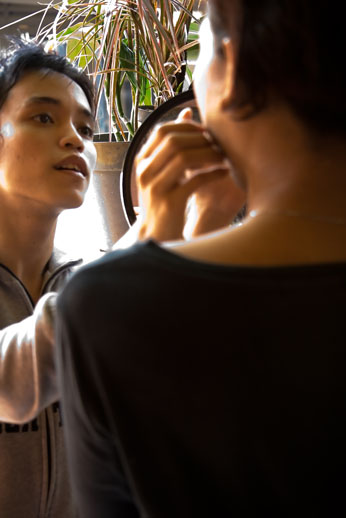 |
Popular stereotype: the waria hair salon worker |
Before she even opens her mouth, the petite, jilbab-wearing and refined looking Shuniyya Ruhama Habiiballah has already gone a long way towards achieving one of her driving missions in life: to challenge the dominant stereotype of Indonesia’s large transgendered community, who describe themselves as waria, a term for transgendered people derived from the words wanita (woman) and pria (man).
As Shuniyya says in her softly spoken, decidedly feminine voice: ‘People see the waria as sex workers on the side of the streets at night, dressed in mini-skirts, with silicone-inflated breasts as large as watermelons. They see the show business drag queens who perform on stage and on television. They see these waria and think that they know what a waria is. They don’t. The waria they see are just the most obvious and easy to identify, and the ones the straight community are most likely to meet.’
Shuniyya is uncomfortable with many of the current definitions of the term ‘waria’, simply because these definitions are not sufficiently inclusive. For example, she disputes well-known gay activist Dede Oetomo’s definition of waria as men who imitate women in their clothing styles or mannerisms ‘while retaining a masculine identity’. She says that while this may be true for some, a significant proportion would strongly disagree that they consider themselves to be men.
‘The waria community is very diverse,’ Shuniyya declares. ‘It includes individuals who continue to identify as male but who imitate certain feminine mannerisms, and perhaps occasionally wear makeup and women’s clothing. Others identify so closely as female that they are able to pass as female in their daily interactions in society. As waria, these individuals become almost invisible.’
Shuniyya is strident in her dismissal of the stereotyped image of the waria as a flamboyant cross-dressing sex-worker living on the fringes of society. ‘Many waria come from middle class backgrounds and have a high level of educational attainment. Many hold respectable positions in established companies. There are waria who work as designers, psychologists and sociologists. The image that all waria are sex workers or employees of hair salons is simply a myth,’ she says. ‘In the end, only a waria knows what it means to be a waria. We have to define ourselves.’
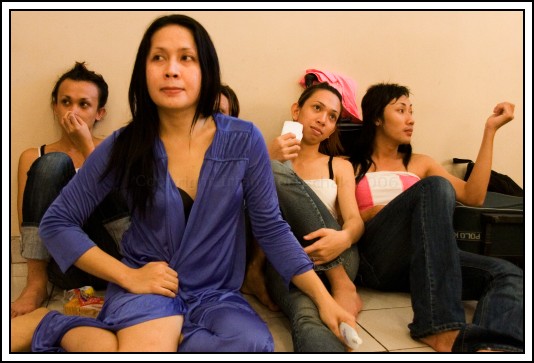 |
Finalists ‘under quarantine’ in JakartaIrfan Kortschak |
However, Shuniyya does acknowledge that social prejudice and discrimination mean that waria often find themselves with limited work options. Very many work in the beauty and cosmetics, entertainment and fashion industries, or in the NGO sector, particularly in NGOs dealing with gender issues. Describing her own employment at a foundation dealing with transgender issues, she says: ‘Looking at me, no-one would guess that I’m not a woman.’ However that does not mean that she has a woman’s freedom to choose her field of employment.
This is because while her identity card (KTP) shows her to be female, other official documents like her birth certificate and academic transcript identify her as male. Legally, there is no precedent for a transgendered individual, including post-operative transsexuals, to alter the gender that that they are identified with at birth. Thus, when applying for almost any form of formal employment or going through any other formal process at which a full range of personal documentation is required, a waria cannot pass as female.
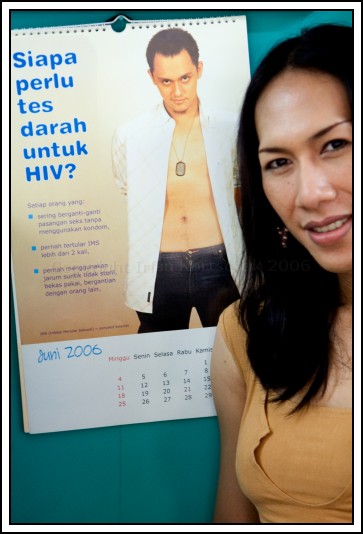 |
HIV/AIDS educationIrfan Kortschak |
Given social attitudes, this bureaucratic hitch is often a critical impediment to obtaining a job. It explains why Shuniyya’s examples of waria who hold respected professional positions seem to be the exceptions, rather than the rule. She seems reluctant to admit that in the face of this strong social prejudice, employment options are limited, and a significant proportion of waria do, in fact, at least occasionally engage in sex work.
The Miss Waria Indonesia pageant
Shuniyya herself is employed at the Yayasan Putri Waria Indonesia, an institute founded by former waria beauty queen Megie Megawatie to keep the Miss Waria Indonesia pageant running as an annual event. From these roots, it is now also involved in a range of other activities, including those related to sexual health education, employment creation, anti-discrimination, and advocacy.
In fact, according to the distinctly glamorous Megie Megawatie, the Miss Waria Indonesia pageant is itself a powerful means of achieving all of these aims. ‘First and foremost, the idea of the pageant is to challenge the stereotype of the waria, not only amongst the broader community, but amongst the waria community itself. We want to demonstrate to the public that we are capable of staging a spectacular, high-profile event in which waria can show the world that they have a diverse range of talents, skills and assets.’
‘We want to demonstrate that waria are an important, integral part of the Indonesian community,’ she says. ‘But perhaps even more importantly, we want to provide members of our own community who may not be secure in their identity with role models. We want them to know that they, too, can be accepted, valued members of society.’
A number of events staged at the pageant are clearly intended to demonstrate that the acceptance of waria into Indonesian society is part of established tradition. In 2006, performances by guest stars included a traditional performance by a troupe of bissu, the group of ritual specialists formerly attached to the royal houses of South Sulawesi, who are often described glibly as ‘transvestite priests’.
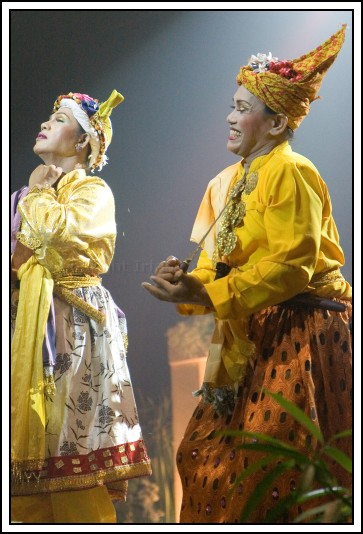 |
Co-opted waria?: bissu from South SulawesiIrfan Kortschak |
The main event of the pageant, the selection of the year’s reigning Miss Waria, follows the pattern established by standard beauty pageants almost entirely, with the usual parades and talent quests. One finalist is chosen to represent each of Indonesia’s 30 provinces, by committees or representative organisations established in each of those provinces. These committees operate with a considerable degree of autonomy, although they conform loosely to standards established by the central organising committee. . . .
Transgendered in Malang
The waria community in this East Javanese city are out in the open, but misunderstanding and prejudice are still widespread.
Kim Heriot-Darragh
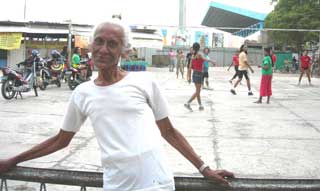 |
Ibu Siama at the volleyball matchKim Heriot-Darragh |
Jumping off a motorcycle in a kampung not far from Malang’s Gajayana train station, I asked some men where I could find Ibu Siama. She had insisted that anyone in this part of town could direct me. My question, however, was met with bemused expressions as the cluster of men tried to deduce just who Ibu Siama might be. Eventually, a look of realisation dawned on one man’s face. He broke into a smile and laughed. His friends were laughing too. ‘Oh, you mean Pak Saleh. He’s over here…’
The confusion arose because I was looking for an 82 year old male to female transgendered person – reputedly, the oldest waria in East Java. The men’s reaction was a good illustration of the position of the transgendered community in Malang: Ibu Siama was not treated maliciously, but she was not taken altogether seriously either.
Conflicting perceptions
While living in Malang in 2006, I encountered a number of waria who varied greatly in their perceptions of themselves, the transgendered community, and the extent to which they felt they were accepted in society. Some looked like men in drag; a couple of others betrayed no indication that they were anything other than women. Some saw themselves as ‘real women’ in a man’s body. Others understood themselves to be a third gender, neither male nor female. I also knew one waria who perceived himself to be fundamentally male: he liked to dress and act as a woman, but ultimately he would die and be buried a man. Though I knew some who sported impressive breasts, I never knowingly met any waria who had undergone a sex-change operation.
In the wider community, perceptions were similarly mixed. Many people are unaccustomed to using the word ‘waria’ to describe transgendered people. More often they use offensive terms like ‘banci’ and ‘bencong’. A neighbour of mine was quick to use the English word ‘faggot’ when he learned of my interest in the local waria community. A number of people were unaware of differences between homosexuals and waria: several times during research work I was introduced to baffled homosexual men.
Waria in society
Despite this confusion about who they really are, waria are certainly an identifiable presence in Malang. No one seems to have heard of any incidences of violence directed at them, even though expressions of hostility against waria are sometimes reported from other cities. Local political parties are aware of the issue of waria (as well as gay) rights. One occasionally hears stories of waria entering mosques dressed as women, and there are a small number of Christian waria who say they have never felt estranged from their religious communities. The majority of waria I knew claimed to have solid relations with their family.
Every few years the Malang city government has offered employment training programs in which waria participants are trained and financially assisted to establish beauty salons (part of an effort to dissuade them from engaging in prostitution). When I enquired in 2006, the Malang city government’s Social Affairs Division told me the last program was held in 2005 and had enrolled 25 participants.
Famous waria enjoy an extensive public profile as entertainers and talk-show hosts. Similarly, Miss Waria Indonesia 2006 Merlyn Sopjan captured considerable public attention, particularly in her hometown of Malang. All copies of her second book, Perempuan Tanpa V (Woman without a Vagina), had apparently sold out by the time of its launch in Malang. Arriving for the launch (broadcast live on a talk-show from the Malang town library), I was surprised by the size and diversity of the audience. The room was packed with university students, waria, and young women wearing jilbab. . . .
POV, Critique, Opinion: Where is our culture?
22 September 2007
Yesterday, I had an experience that I haven’t been able to stop thinking about since. I was outside for a few minutes, and a kid, probably about eleven or twelve, pedaled by on his bicycle. He kept looking over his shoulder at me, and then quickly rode away. Just as I was going back inside, the kid came back around the block. As I was closing the door behind me, I heard a young voice say excitedly “I saw the homo! I saw the homo!”.
Yeah, fun times. Not that I actually care what a twelve-year-old and his friend think of me, but it is interesting nonetheless. I’ve apparently become something of a neighborhood attraction. I suppose this really shouldn’t surprise me. I go outside in all manner of gendered presentation, full makeup, no makeup, boobs, no boobs. Of course, I don’t actually go anywhere unless I’m properly put together, but I’m not going to bother just to walk to the mailbox or get something from my car. This particular time I was in full makeup, hair done, but I’d changed out of what I was wearing…all of it, including most of my bust…and was wearing sweat pants and a Josie and the Pussycats t-shirt. Oh and of course, my nails are done. In other words, I was looking about as totally genderqueer as I get. It’s a look I’m perfectly comfortable in at home or around certain close friends and family, but it’s not really something I do intentionally, by actually going for that look (anymore).
What’s most interesting to me about this is not that these kids think I’m a sideshow attraction, but that they think it’s because I’m homosexual. I resist the temptation to label this kid a bigot because I doubt he’s old enough to have any real understanding of what a “homo” actually is. Hell, he might turn out to be one himself in just a few short years. And yet, even though the ignorance of a child is surely not a reliable guide in such things, I find myself wondering if that’s part of the problem, that for the most part, despite all the political progress we’ve made recently, we’re still essentially socially and culturally invisible as transpeople in mainstream society.
I’m not talking politics here, not really. What I’m starting to wonder is if transpeople are perceived as joined at the hip with gays and lesbians because we want to be. That begs the question, of course, DO we want to be? Of course, it makes sense politically, but where is the culture that belongs to transpeople alone? Can we even say we really have one?
There are many aspects of gay and lesbian culture, especially those involving sex and romance, where transpeople often find themselves welcome to be present but not participate, or are simply excluded from. Where are the corresponding trans-exclusive spaces? They are out there, but you’ll have to search them out, and of course, that’s assuming you have a trans community in your area which cares enough to create one.
A few years ago, I co-founded a weekly trans group rap at my local Pride Center. We got a few people the first few meetings, and then…nothing. No one. After a few more, we gave up. As far as I know, the one and only trans group that still meets at the Center is the Gender Rights Advocacy Association of New Jersey (GRAANJ), the political advocacy group.
There’s more to life than politics, despite how it probably feels to a lot of us sometimes. It’s wonderful that we share so many cultural spaces with gay and lesbian people. In many ways, it’s an excellent model of how other differences, such as race and ethnicity, can be all but ignored within the greater context of a community, even as many in that community will tend to divide up along gender lines socially. The problem comes in when you try to fit unconventionally-gendered people into gender-specific spaces. Sometimes it works, sometimes it doesn’t, and sometimes it works for some but not for others.
Those of us who create media can help in that, but our impact goes only so far. We can give people a place to come together and to speak to each other through the media we create, but there’s always a buffer there, the media we use in which to get our message out. Some media, like talk radio, is personal, community-oriented, and very interactive. Other media, like the Internet or print media, is less or non-interactive but still helps tour community connect to each other. We can speak to and speak with our community on the grand, worldwide scale far more efficiently than we’re able to face-to-face, person-to-person.
Gays and lesbians generally don’t have this problem, or at least, not to the extent we transfolks do. Think fast: How many local gay bars or clubs can you name? Now, how many lesbian bars? And how many tranny bars?
I used to know of two tranny bars in Manhattan, but one got shut down during the Giuliani Administration. The other, Edelweiss, I believe is still around…and that’s it, as far I know, for the entire City of New York. Nothing in Jersey, except for a club I knew of in Atlantic City twenty-five years ago, nothing in Philly. Even the Pride Centers of these cities don’t offer a whole lot for us.
Where is transgender culture?
For transpeople, it seems that home is where the Internet is. The largest physical gatherings of transpeople almost always involve an event to which transpeople often must travel a long distance in order to attend, such as a organizational convention, and many of these events are wrapped up in political advocacy. Aside from those kinds of events, the vast majority of our intra-community socialization takes place online.
It’s not surprising, therefore , that most of our community-relevant media is Internet-based as well. Attempts have been made to bridge the cultural gap between the transgender community and the mainstream, but none have proven truly successful yet. We have no LOGO, nothing on Bravo, nothing that really serves that kind of gate-opening role for transpeople that Ellen Degeneres and “Will and Grace” did for gays and lesbians.
As someone who has made her own attempts at trying to span that divide, even after all this time I still wonder how long it will be before the mainstream media begins to get us as well and starts to incorporate us and our perspectives into the mainstream. When you’re still fighting for representation in even the mainstream media which is directly intended and marketed to your own community, hoping for real mainstream inclusion may be just a pipe dream..for now.
Where is transgender culture?
Chances are, you’re not going to find it by turning on your television or even your radio. If you’re not actually travelling somewhere where it happens to surface periodically on a regular basis, you’re probably going to find it online and in print. You can read a hundred writers and get a hundred different takes on what it means to be a transgender person. You can listen to and participate in shows like mine or Ethan’s for social and political talk and debate. You can listen to any of the many great podcasts being created by transpeople. There’s relevant trans community media out there for those who want it and seek it out, but precious little for those who can’t or won’t dig deep enough to find it.
It’s not unreasonable to believe that the reason why everyone seems to think we’re all just another variety of “homo” is because that’s what most of our popular media tells people we are, intentionally or not. We can create our own versions of virtual transgender community centers and rap groups, but it won’t be until our faces, voices, and perspectives become an integral part of popular media that we’ll begin to see that perception begin to change socially and politically in the mainstream in any real way.
Where is transgender culture?
When you really get right down to it, it’s in our hearts, in our minds, in our voices, and in our fingertips. It’s in our collective desire to reach out to each other and be a part of something far greater than ourselves. It’s in the lives we live, the media we create, and the relationships we develop with others like ourselves and those who care about us. It’s in the way we present ourselves, both to the outside world and to each other. It’s in the way we work together, play together, love together, mourn together, and fight together. It’s in how we speak up and say “We are here!”.
It’s not what others have, and maybe it never will be, but, for now, transgender culture is whatever those of us who reach out to touch each other make of it. Until we have the tools to take it to the next step, though, it’ll have to be enough. I just hope we won’t have all that much longer to wait.
Yesterday, I had an experience that I haven’t been able to stop thinking about since. I was outside for a few minutes, and a kid, probably about eleven or twelve, pedaled by on his bicycle. He kept looking over his shoulder at me, and then quickly rode away. Just as I was going back inside, the kid came back around the block. As I was closing the door behind me, I heard a young voice say excitedly “I saw the homo! I saw the homo!”.
Yeah, fun times. Not that I actually care what a twelve-year-old and his friend think of me, but it is interesting nonetheless. I’ve apparently become something of a neighborhood attraction. I suppose this really shouldn’t surprise me. I go outside in all manner of gendered presentation, full makeup, no makeup, boobs, no boobs. Of course, I don’t actually go anywhere unless I’m properly put together, but I’m not going to bother just to walk to the mailbox or get something from my car. This particular time I was in full makeup, hair done, but I’d changed out of what I was wearing…all of it, including most of my bust…and was wearing sweat pants and a Josie and the Pussycats t-shirt. Oh and of course, my nails are done. In other words, I was looking about as totally genderqueer as I get. It’s a look I’m perfectly comfortable in at home or around certain close friends and family, but it’s not really something I do intentionally, by actually going for that look (anymore).
What’s most interesting to me about this is not that these kids think I’m a sideshow attraction, but that they think it’s because I’m homosexual. I resist the temptation to label this kid a bigot because I doubt he’s old enough to have any real understanding of what a “homo” actually is. Hell, he might turn out to be one himself in just a few short years. And yet, even though the ignorance of a child is surely not a reliable guide in such things, I find myself wondering if that’s part of the problem, that for the most part, despite all the political progress we’ve made recently, we’re still essentially socially and culturally invisible as transpeople in mainstream society.
I’m not talking politics here, not really. What I’m starting to wonder is if transpeople are perceived as joined at the hip with gays and lesbians because we want to be. That begs the question, of course, DO we want to be? Of course, it makes sense politically, but where is the culture that belongs to transpeople alone? Can we even say we really have one?
There are many aspects of gay and lesbian culture, especially those involving sex and romance, where transpeople often find themselves welcome to be present but not participate, or are simply excluded from. Where are the corresponding trans-exclusive spaces? They are out there, but you’ll have to search them out, and of course, that’s assuming you have a trans community in your area which cares enough to create one.
A few years ago, I co-founded a weekly trans group rap at my local Pride Center. We got a few people the first few meetings, and then…nothing. No one. After a few more, we gave up. As far as I know, the one and only trans group that still meets at the Center is the Gender Rights Advocacy Association of New Jersey (GRAANJ), the political advocacy group.
There’s more to life than politics, despite how it probably feels to a lot of us sometimes. It’s wonderful that we share so many cultural spaces with gay and lesbian people. In many ways, it’s an excellent model of how other differences, such as race and ethnicity, can be all but ignored within the greater context of a community, even as many in that community will tend to divide up along gender lines socially. The problem comes in when you try to fit unconventionally-gendered people into gender-specific spaces. Sometimes it works, sometimes it doesn’t, and sometimes it works for some but not for others.
Those of us who create media can help in that, but our impact goes only so far. We can give people a place to come together and to speak to each other through the media we create, but there’s always a buffer there, the media we use in which to get our message out. Some media, like talk radio, is personal, community-oriented, and very interactive. Other media, like the Internet or print media, is less or non-interactive but still helps tour community connect to each other. We can speak to and speak with our community on the grand, worldwide scale far more efficiently than we’re able to face-to-face, person-to-person.
Gays and lesbians generally don’t have this problem, or at least, not to the extent we transfolks do. Think fast: How many local gay bars or clubs can you name? Now, how many lesbian bars? And how many tranny bars?
I used to know of two tranny bars in Manhattan, but one got shut down during the Giuliani Administration. The other, Edelweiss, I believe is still around…and that’s it, as far I know, for the entire City of New York. Nothing in Jersey, except for a club I knew of in Atlantic City twenty-five years ago, nothing in Philly. Even the Pride Centers of these cities don’t offer a whole lot for us.
Where is transgender culture?
For transpeople, it seems that home is where the Internet is. The largest physical gatherings of transpeople almost always involve an event to which transpeople often must travel a long distance in order to attend, such as a organizational convention, and many of these events are wrapped up in political advocacy. Aside from those kinds of events, the vast majority of our intra-community socialization takes place online.
It’s not surprising, therefore , that most of our community-relevant media is Internet-based as well. Attempts have been made to bridge the cultural gap between the transgender community and the mainstream, but none have proven truly successful yet. We have no LOGO, nothing on Bravo, nothing that really serves that kind of gate-opening role for transpeople that Ellen Degeneres and “Will and Grace” did for gays and lesbians.
As someone who has made her own attempts at trying to span that divide, even after all this time I still wonder how long it will be before the mainstream media begins to get us as well and starts to incorporate us and our perspectives into the mainstream. When you’re still fighting for representation in even the mainstream media which is directly intended and marketed to your own community, hoping for real mainstream inclusion may be just a pipe dream..for now.
Where is transgender culture?
Chances are, you’re not going to find it by turning on your television or even your radio. If you’re not actually travelling somewhere where it happens to surface periodically on a regular basis, you’re probably going to find it online and in print. You can read a hundred writers and get a hundred different takes on what it means to be a transgender person. You can listen to and participate in shows like mine or Ethan’s for social and political talk and debate. You can listen to any of the many great podcasts being created by transpeople. There’s relevant trans community media out there for those who want it and seek it out, but precious little for those who can’t or won’t dig deep enough to find it.
It’s not unreasonable to believe that the reason why everyone seems to think we’re all just another variety of “homo” is because that’s what most of our popular media tells people we are, intentionally or not. We can create our own versions of virtual transgender community centers and rap groups, but it won’t be until our faces, voices, and perspectives become an integral part of popular media that we’ll begin to see that perception begin to change socially and politically in the mainstream in any real way.
Where is transgender culture?
When you really get right down to it, it’s in our hearts, in our minds, in our voices, and in our fingertips. It’s in our collective desire to reach out to each other and be a part of something far greater than ourselves. It’s in the lives we live, the media we create, and the relationships we develop with others like ourselves and those who care about us. It’s in the way we present ourselves, both to the outside world and to each other. It’s in the way we work together, play together, love together, mourn together, and fight together. It’s in how we speak up and say “We are here!”.
It’s not what others have, and maybe it never will be, but, for now, transgender culture is whatever those of us who reach out to touch each other make of it. Until we have the tools to take it to the next step, though, it’ll have to be enough. I just hope we won’t have all that much longer to wait.
Brown University: Deserving a debate
Issue date: 9/24/07 Section: Editorial
Excited rhetoric on both sides may obscure the issue, but the debate over gender-neutral facilities at Brown has a fairly straightforward problem at its core: Transgender students, who are among those in our community most vulnerable to abuse and discrimination, are not well-served by gender-segregated housing and other facilities. Greater flexibility for first-year housing and gender-neutral housing for upperclassmen deserve serious campus debate and consideration.
Taking the issue of gender-neutral housing and bathrooms seriously is difficult because, quite simply, we do not live in a gender-neutral society. Our language isn't equipped to deal with people who do not fit into the so-called "gender binary." Our society recognizes important and real differences between men and women. Allowing male and female students to live together is not the purpose of these changes. But the implications of that - and the potential that male and female students would be uncomfortable sharing a bathroom - are legitimate concerns.
Yet ultimately, as Interim Vice President for Campus Life and Student Services Russell Carey '91 MA'06 points out, the purpose of gender-neutral facilities is "to provide choice and options so all students feel comfortable and safe in their living environment." The Human Rights Campaign notes that one expert estimates that transgender individuals in the United States have a one-in-12 chance of being murdered, compared with a one-in-18,000 chance for the general population. Brown is and should be a space of tolerance and respect. But between 2003 and 2005, there were 52 hate crimes on campus ranging from assault (reportable) to vandalism (non-reportable), according to Department of Public Safety data. We shouldn't delude ourselves into thinking that discrimination is a problem for other people.
UK: ‘It took 46 years to stop me living a lie’
Sep 24 2007 | |
by Peter Collins, South Wales Echo | |
FOR most of his life, 46-year-old Andrew Cross has been tortured by the feeling that inside his man’s body and mind a woman has been aching to get out.
Suppressing the almost overwhelming feelings he had of being a woman led the former chef in the Royal Naval Reserve to sink into the depths of depression.
From his early 40s he suffered Bipolar Affective Disorder, often known as manic depression, which saw his moods swing like a pendulum from abject despair to sublime elation.
Various treatments and medication for the disorder helped for short periods, but the underlying cause – his need to be a woman – remained.
That was until December 12 last year when Andrew John Cross, of Barry, decided to become Anne-Marie Cross, of Barry.
The life-changing decision was celebrated at the Golden Cross pub, in Cardiff, and also at the city’s Barfly nightspot.
In her first press interview on her life-changing experience, Anne-Marie told the Echo how, despite losing friends and family because of her decision, she was optimistic about the future and was preparing to launch a book about her life. The book will tell how Cardiff-born Andrew was engaged to be married on two occasions, first when he was 28 and again when he was 32.
Both relationships failed because of his need to be a woman.
He had “15 great years” travelling around the world with the Royal Naval Reserve, ending when he was 40 years old, when he suffered his first major attack of manic depression.
“The depression was always there,” said Anne-Marie. “But it surfaced when my father died and because I was suppressing my need to be a woman.” . . .
Sunday, September 23, 2007
David Tennant's British TV Debut as a Transsexual Barmaid
Here's David Tennant (The current "Doctor Who") in his first ever role on television, playing a pre-op transsexual bar maid called "Davina."
Subscribe to:
Comments (Atom)
